Chapter 8
Bread for a Knife
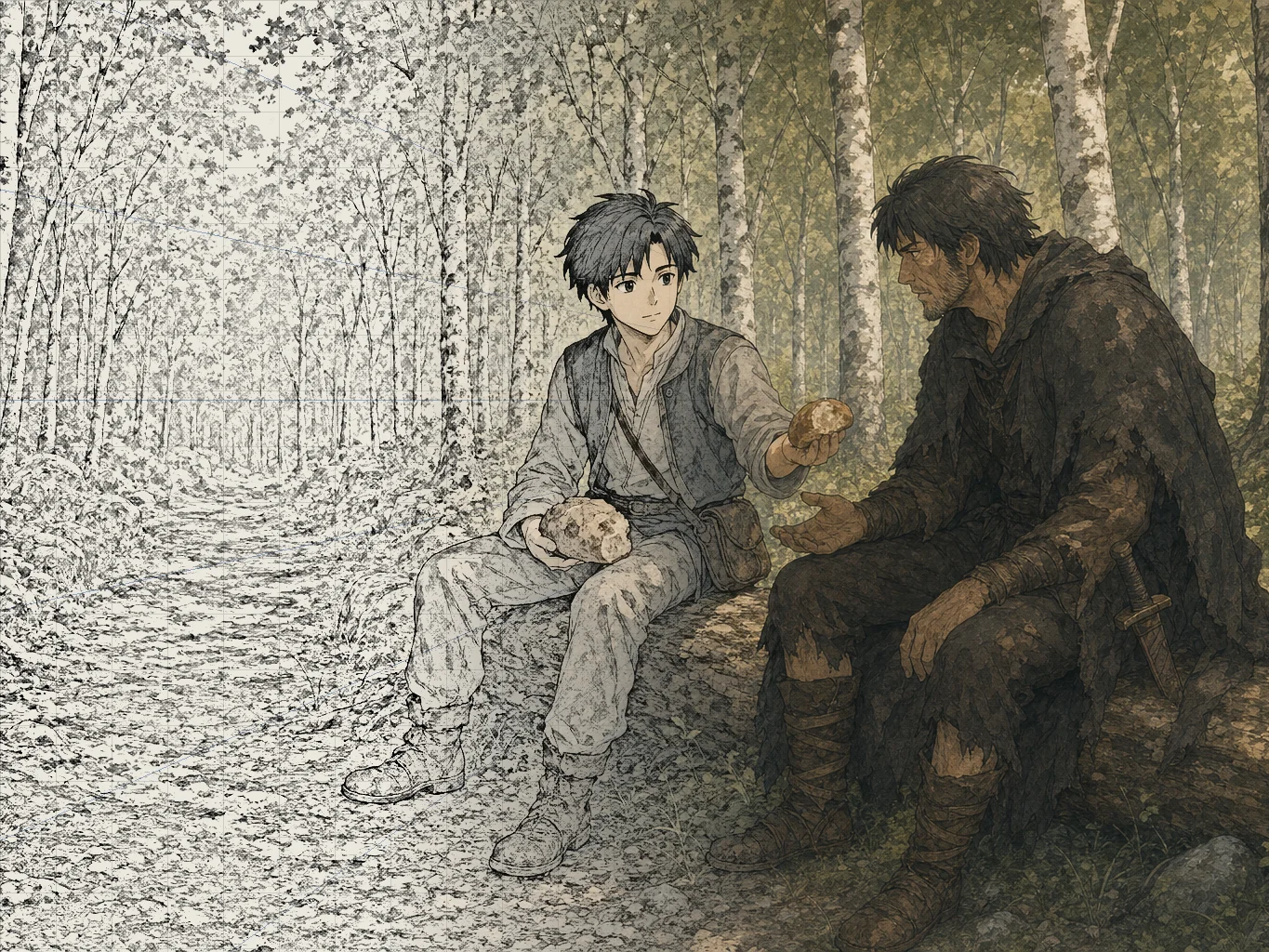
Ten days into the journey, Aelios met the man on the forest road.
He had been walking since dawn through a stretch of old woodland west of the Drennick farmlands — not the Emberwood, which was behind him and a world away, but a different forest, thinner and less patient, the kind that grows in the gaps between settled country and lets the road pass through without objecting. The trees were birch and alder, pale-barked, and they let enough light through to see the road ahead, which allowed Aelios to mark the man before the man could mark him.
He sat on a stump at a bend in the road, positioned where the path narrowed between two fallen trunks so that anyone coming through would have to pass within arm’s reach. He was not large. He was not armed in any impressive way — a knife at his belt, short and dull-looking, the kind of blade you buy in a market when you can’t afford the kind you want. His clothes were road-worn and patched at the elbows, and his face had the particular hollowness of a man who had been eating badly for a long time and had stopped being surprised by it.
He stood when Aelios came around the bend. The knife stayed in his belt, but his hand moved to it, and the movement was the message.
“Your pack,” the man said. His voice was flat. Not threatening — tired. The voice of a person performing a task he does not enjoy but has run out of alternatives to. “Whatever you’re carrying. Leave it and keep walking.”
Aelios stopped. He looked at the man. He looked at the knife. He looked at the narrowed road, the fallen trunks, the distance between them. His mind did what his mind always did: it assessed. The man was taller but thinner. The knife was short and poorly maintained. The road was narrow, but the forest on either side was open enough to run through if running became necessary. The man’s position was tactical — he had chosen the bend well — but the way he held himself was not. His weight was back on his heels. His shoulders were hunched. He was bracing for a fight he did not want to have.
Aelios sat down.
Not on the ground — on one of the fallen trunks, the one nearest him, settling onto the bark with the unhurried motion of someone who has decided that this particular moment does not require haste. He swung his pack off his shoulder and set it on the trunk beside him — deliberate, visible, slow enough that the man could see exactly what was happening and understand it was not a threat.
The man stared at him.
“What are you doing?”
“Sitting,” Aelios said. He opened the pack and took out the cloth-wrapped loaf he had bought in Drennick two days ago. It was good bread — dense, dark, the kind that kept for a week and tasted better for it. He broke it in half. He held out the larger piece.
The man did not move. His hand was still on the knife. His eyes moved from the bread to Aelios’s face and back again, performing an animal calculation — the assessment of a creature that has been offered something and cannot determine whether the offering is a trap.
“You look like you haven’t eaten today,” Aelios said. “Neither have I. The bread is two days old but it’s from the Drennick baker and he knows what he’s doing.”
The silence lasted long enough for a crow to call somewhere in the canopy above them. Then the man’s hand left the knife, and he sat down on his stump, and he took the bread, and he ate it like a man pretending not to be hungry — slowly, with controlled bites, maintaining the dignity of a transaction he had already lost control of.
Aelios ate his half. He chewed and watched the road and said nothing, because he understood — in the efficient, clinical way he understood most things about people — that the man needed a moment to rearrange his sense of what was happening before a conversation could take place. A boy was supposed to be afraid. A boy was supposed to hand over his pack and run. A boy was not supposed to sit down and share bread with the man robbing him. The wrongness of it had knocked something loose in the man’s machinery, and the machinery needed time to right itself.
The man finished the bread. He brushed the crumbs from his hands. He looked at Aelios with an expression that was no longer flat but curious — the wary, off-balance curiosity of someone who has been surprised in a way that is not unpleasant.
“You’re either very brave or very stupid,” he said.
“Neither,” Aelios said. “I’m just not carrying anything worth dying over, and you don’t look like you want to kill anyone today.”
The man let out a sound that might have been a laugh if it had been given more air. “You’d be surprised what a man wants when he’s hungry enough.”
“You’re not hungry now.”
Another almost-laugh. The man rubbed his face with both hands — the gesture of a person surfacing from a place they have been submerged in for too long. When his hands came down, the hollowness was still there, but the edge had softened, and behind the edge there was a person, and the person was tired in a way that had nothing to do with sleep.
“Where are you headed?” the man asked.
“West. The Capitol.”
“Long walk for a boy alone.”
“It is.” Aelios reached into his pack and took out three coins — not all he had, but enough to matter. He set them on the trunk between them. “I could use information more than I could use a fight. The roads ahead — which passes are safe, where to find shelter, which towns have inns that don’t charge more than they’re worth. You know this country. I don’t.”
The man looked at the coins, then at Aelios. The calculation happened again, but this time it was not animal. It was human — the assessment of a person deciding whether to be what he had been or what he might still become. The decision balanced on a fulcrum no more complicated than a half-loaf of bread, three coins, and a boy who had looked at him without fear.
He took the coins.
And then he talked. For the better part of an hour, while the afternoon light slanted through the birch canopy and the road stayed empty, the man told Aelios everything he knew about the country ahead. The Greywater crossing, where the bridge had been out since spring and the ford was only passable at low water. The town of Thornwall, where the west road met the southern trade route, which had the only reputable inn between Drennick and the lowlands. From Thornwall, he said, you turned south — the road ran through open farmland where a boy travelling alone would draw less attention, and from there it was still a week or two to the Capitol. He spoke of the Capitol itself last. He had visited once years ago, before things went the way they went, and he described it with the grudging respect of a man humbled by a place he had never quite forgiven.
Aelios listened. He asked precise, specific questions — distances, landmarks, the names of innkeepers who could be trusted and the names of those who could not. The man answered. By the end of the hour the transaction had shifted from robbery to commerce to something that was, if you squinted at it in the right light, almost a conversation between two people who had found themselves, briefly and unexpectedly, useful to each other.
When Aelios stood to leave, the man stood with him. He extended his hand. Aelios took it. The grip was firm, the knuckles rough, the shake brief and businesslike — but beneath the business there was something else: the flicker of a debt being registered. The man owed a boy a kindness, and he would not forget. People who have been hungry rarely forget the hand that fed them.
“The name’s Torren,” the man said. “If you ever come back through this stretch of road and need a friend, ask for me at the Greywater crossing. I’m there more often than not.”
“I’ll remember,” Aelios said.
He shouldered his pack and walked on. Behind him, Torren sat back down on his stump, three coins richer and half a loaf of bread fuller, and the knife at his belt was a little less necessary than it had been an hour ago, and the boy walking west was a little less alone.
That night, Aelios made camp at the edge of a cleared field where the tree line gave way to open country.
At the field’s edge, where the last grass met the dark of the trees, a hill-hare sat in the stubble. It did not bolt at his arrival, did not flatten itself into the cover. It sat with the patient, oriented stillness of a creature whose attention was fixed on a point in the middle distance only it could see. Aelios watched it. He waited for it to move but it did not. He turned to gathering wood.
He built a fire. The process was unremarkable — tinder, kindling, the careful arrangement of sticks in a loose pyramid that he had learned from watching his father rebuild the cottage’s cookfire every morning for fifteen years. The flint stayed in his pack. The flame was already in the kindling by the time he sat down — steady, even, proportional to the fuel. It did not surge. It did not roar. It did not lean or bend or reach for anything it was not given. It simply burned, the way fire burns when it is doing what it is meant to do and nothing else.
Aelios sat beside it and read his notes by its light. The fire illuminated the pages with a warm, consistent glow, and the glow did not flicker, and the flame did not gutter, and the coals arranged themselves in the ring of stones he had placed around them with the tidy, self-contained precision of a thing that has been told where its boundaries are and has no interest in testing them.
He read until the light was too low to see by, and then he lay on his back and looked at the stars, and the stars were ordinary — arranged in the patterns he had learned as a child, the constellations undisturbed, the Valarcan alignment a memory rather than a presence — and the ordinariness was a relief.
As he drifted toward sleep, something stirred in his chest. Faint. Brief. A warmth that was not the campfire’s — deeper, older, the same warmth that had pooled in the corner of a burning cottage and decided, without being asked, not to reach him. The warmth suggested, not with words but with sensation, that the man on the road could have been handled differently. An idea, a reach, a letting go of something Aelios had not known he was holding — and the man on the stump would not have seen morning.
He took the suggestion in as he took in everything — as one more fact, to be weighed and set in its place. Then he set it aside without ceremony, and he was asleep within minutes. The fire beside him burned low and steady through the night. In the morning the ashes were cool and grey and held their shape perfectly, as though the fire had consumed its fuel with such precision that nothing had been wasted and nothing had been left to chance.
He reached the crossroads town of Thornwall near the end of the second week. Thornwall sat at the junction of two trade roads — the east-west route he had been following and a north-south artery that connected the mountain settlements to the lowland markets. It was larger than Drennick, busier, louder — the kind of town that existed because roads crossed and people needed somewhere to argue about prices. The inn was where Torren had said it would be, and the innkeeper was who Torren had said he would be: a heavy, quiet man who asked no questions, charged fair rates, and kept the ale honest.
Outside the inn, a ragged minstrel sat against the wall with a battered lute, playing for the coins in the cap at his feet. The playing was poor. Aelios stopped to the end of the tune and dropped a coin in — more than it had earned. Nothing in the music had moved him; he simply understood that a kindness given where none was owed was remembered far longer than it cost. The minstrel bobbed his head in thanks. Aelios was already walking on.
Aelios took a room. He washed. He ate a meal that was hot and unremarkable and more satisfying than anything he had tasted in weeks, because hot and unremarkable is what the body wants after a month of bread and cold water and ten hours a day on the road.
He spent the evening in the common room, listening.
The conversations were the same as everywhere — the Valarcan Sky, the old legends, the fear that had settled over Veridion like a low fog that would not lift. But here, at a crossroads, the fear was thicker. Travelers spoke of phenomena that did not behave as they should — ground that shook without cause, water that moved against its nature, winds that obeyed no season. The details shifted with the teller and the drink, but the shape of every story was the same: something in the world had come loose, and no one could say what, and the silence around it only fed the fear.
The Etherborn, however. This word surfaced in every conversation, sooner or later, like a stone surfacing in a river — inevitable, immovable, the word everything else flowed around. They were destroyers. They were the cause. They were the reason the world had broken and the reason it would break again. The variations were local but the verdict was universal. Aelios sat in his corner and let it wash over him, and it left no mark, because he was not a boy who accepted verdicts. He was a boy who required evidence.
In the morning he paid the innkeeper and took the southern road out of Thornwall. It passed through the market quarter, where the smiths had their workshops, and the forges were already lit, and the clang of hammers on metal rang across the rooftops in the flat, rhythmic percussion of a town that was awake and working.
He passed the largest forge at the end of the street. It was an open-fronted workshop — stone walls, timber roof, the wide brick hearth glowing orange in the grey morning light. The smith was a broad woman in a leather apron, working a piece of iron on the anvil with the economical, practiced strokes of someone who had been doing this so long the hammer was an extension of her arm.
As Aelios walked past the open front of the forge, the fire in the hearth flared.
It was brief — a single, sharp brightening, the flame leaping a hand’s breadth higher for the space of a breath or two before settling back to its working height. The kind of thing that happens in forges: a pocket of air in the coal, a shift in the draught, a log settling. The kind of thing no one notices unless they happen to be looking at the exact right moment.
The smith looked up from her work — the hearth, then the road, the boy walking past with a satchel over his shoulder and his eyes fixed on the distance ahead, then back to the hearth. The fire was normal. The coal was arranged as she had arranged it. Nothing was wrong.
She shook her head and went back to her work.
Aelios walked on. The flare had passed him. The warmth had passed him. He was already fifty yards past the forge, his mind occupied by the road ahead and the calculations it required — days to the lowlands, days to the Capitol, the dwindling coin in his pack and the growing list of questions in his satchel — and the fire in the forge behind him was as irrelevant to him as the crows in the trees and the mud on the road and every other ordinary sight that a boy walks past without noticing on a long journey west.
The smith watched him go. She did not know why she watched. She turned back to the iron on her anvil, and the hammer fell, and the forge burned, and the morning carried on.
The Capitol was still weeks away. The road was long and the boy on it was young and alone and carrying questions that no one he had met so far could answer.
But the questions were patient. They had waited fifteen years in a cottage that no longer existed. They could wait a few weeks more.
Aelios walked south, and the road widened, and the world opened before him, and somewhere behind the horizon the Capitol waited with its colleges and its libraries and its centuries of accumulated knowledge. The warmth in his chest stirred once — faint, sourceless, the same quiet heat that had suggested options for the man on the road — and he noted it, and let it settle among the other mysteries he did not yet understand, and kept walking.
Certainty was a tool. Aelios had been sharpening his since the night the fire decided not to take him.
Marginalia
No notes yetOther readers’ notes are open for you to read. To leave one of your own — or to react to someone else’s — request full access.
No notes here yet.