Chapter 7
In the Deep Wood
The Emberwood rose ahead of him like a wall.
Not the southern tree line where he had gathered kindling — that was behind him now, to his left, a familiar edge he had worked along a hundred times. The path east skirted the forest’s southern border and then curved into it, following a track that was more suggestion than road: a narrow line of packed earth where the grass grew shorter and the deer trails converged, leading into the trees with a quiet insistence, the forest gathering the path inward as it went.
Emrys had never taken this path. No one in Windward Hollow did, not willingly. The eastern Emberwood was the deep forest — the part the stories were about, the part where the ruins were, the part where the light changed and the sounds didn’t match and the air carried that green, peat-thick smell that meant you had gone further than you should.
He walked into it anyway.
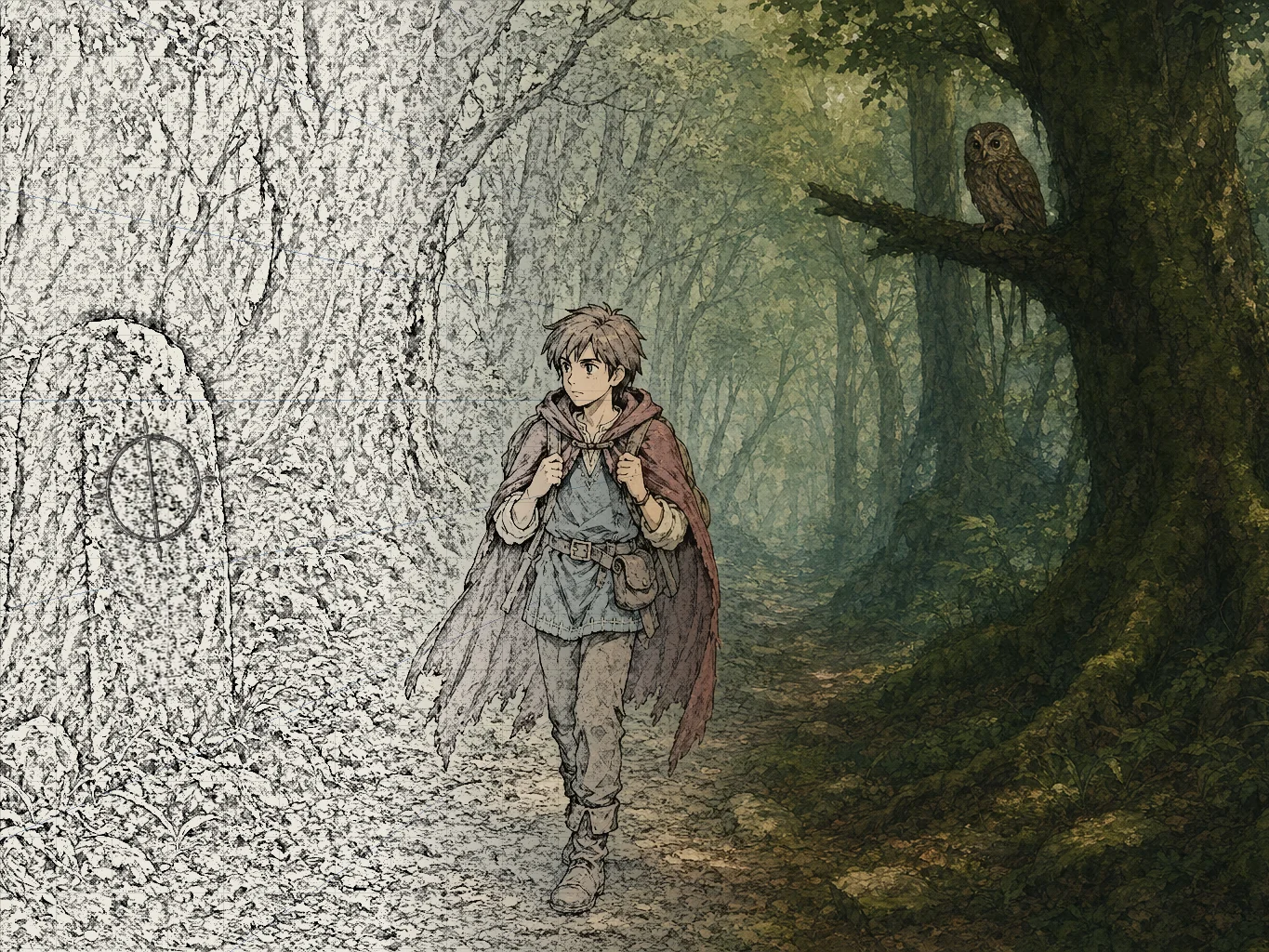
The canopy closed overhead. The light dimmed. The frost on the grass gave way to a carpet of fallen leaves, brown and gold and the deep, wet black of decay, and the sound of his boots changed — from the crisp crunch of frozen ground to the soft, muffled press of leaf on damp earth. The trees grew taller and closer together, and the sky narrowed to a strip of grey between the branches, and the silence was the silence of a full place: layered, textured, alive with the small sounds of creatures watching him pass and undecided what to make of him. An owl watched from a branch overhead, head tilted, one eye flat and bright. Something quick and dark — a stone-marten, perhaps — moved along a fallen log and vanished into the undergrowth before he could be sure of it. The hum in his chest was steady. It had been steady since he left the cottage — not louder, not quieter, but settled, as though it approved of the direction he was moving. He did not know if that was comforting or frightening. He decided it did not matter. Garlen’s sword shifted at his hip with each step, an unfamiliar weight he had not yet learned to walk without noticing.
A path like this he had walked before, smaller, when a foot behind him had hooked his ankle and the lane had risen to meet his face. Mud had crusted under his shirt by the time he reached home. Mirna had not been told how it got there.
He walked for an hour. The path held. The trees thickened. The light continued to dim, not because the day was ending but because the forest was deepening, drawing itself in around him like a cloak. No one was there. Nothing made a sound. But the pressure was on him — in the way of a gaze on the back of your neck, or a room that has too many people in it. The forest was aware of him — aware in the same manner as the fire, as the sky — and the awareness was neither hostile nor welcoming but simply attentive, in the way of very old presences that have learned to wait.
The path curved. The trees opened briefly into a clearing — a small, rough circle of grass and stone, ringed by oaks so old their roots had risen out of the earth like the knuckles of buried hands. In the centre of the clearing, half-swallowed by moss and fallen leaves, a stone marker rose from the ground. It was roughly waist-high, weathered to the colour of bone, and on its face someone had carved a symbol that Emrys did not recognise: a circle, bisected by a vertical line, with four smaller marks arranged at the cardinal points.
He stopped. The hum in his chest pulsed once — a single, bright flare, like a heartbeat through a wall.
He did not know what the marker meant. He did not know who had placed it here, or when, or why. But the symbol on its face resonated with something inside him — not knowledge, not memory, but the space where knowledge and memory should have been, the hollow place at his centre that Darrin’s words had found and the stranger’s words had named and the Valarcan Sky had illuminated in a single, terrifying flash.
He reached out and touched the stone. It was cold. Solid. Ordinary. But the hum flared again when his fingers made contact, and for just an instant — so brief it might have been imagination — the symbol seemed to warm beneath his palm, as though the stone remembered something that the boy touching it had not yet learned. He pulled his hand back. The flare subsided. The forest was quiet.
Ahead of him, the path continued east, narrowing into the deeper trees, disappearing around a bend where the light was green and gold and uncertain. Behind him, the way he had come was already hard to distinguish from the forest floor, the path blending into the leaves and the forest floor as though the Emberwood were closing itself behind him, sealing the road back to Windward Hollow.
He adjusted the sack on his shoulder. He checked the knife at his belt. His mind went to Mirna’s face in the doorway, and Garlen’s trembling hand on the table, and the door closing behind him, and the sound it had made — a soft, final click, the smallest sound in the world, carrying the largest weight.
He turned east, and he walked.
The forest received him. The path unfolded. The hum beat steady as a drum, marking the rhythm of a journey that had no map and no destination and no promise of return — only the one word a stranger had left on a kitchen table behind him.
Direction.
It would have to be enough.
The silence was the first thing that got to him.
Not the forest. Not the dark. Not the cold or the ache in his shoulders from the sack. It was the absence of other people. In Windward Hollow, even in the dead of night, there had been presence — Mirna’s breathing through the wall, the creak of Garlen shifting in bed, the dog two houses over that barked at nothing every hour. Sound you stopped noticing until it was gone, and then its absence was deafening.
He walked. The Emberwood closed around him, and he walked.
Why did they leave me? Did they know what I was?
The questions surfaced before he could stop them — the old questions, the ones that had lived at the bottom of every other question he had ever asked. He had asked Mirna once, when he was very small. Where did I come from? And she had held him, and her answer had been warm and gentle and completely empty: You came to us, and that’s enough. For years it had been enough. But enough is a dam, not an answer, and the water behind it had been rising for a long time, and the dam was cracking now.
What am I?
He said it aloud. The forest did not answer. Etherborn was a word the village used to frighten children — the destroyer in the old stories, the world-breaker — and it was not a thing a person could be. It was a thing a person could be afraid of. And yet the flames had bent around him in the Ashworth corridor. The sky had reached for him in the Emberwood. The hum behind his breastbone had not gone quiet since, as though something were living inside him that had been sleeping for a very long time and had finally, irrevocably, woken up. The question hung in the air a moment and then fell, unanswered, into the dead leaves at his feet.
He found the second marker at a stream crossing in the late afternoon.
It stood like the first — waist-high, bone-coloured, carved with the circle and the line and the four points. The hum pulsed when he knelt beside it. A single warm throb, like a hand pressed briefly to his back. This way. Keep going.
He kept going. And the questions kept coming.
Had Mirna known? Not the details — not the fire, not the Valarcan Sky, not the word Etherborn — but the shape of it? Had he been lent rather than given, placed in her care by someone who had known what he was before he did? If he was — whatever he was — then someone had known before he did, and someone had buried him in a quiet village like a secret you do not want found.
A mother knows. Even one who came to it the way I did.
Her words, from the night before he left. She had known about his fear of fire — known it since always, she said. What else had she carried in silence, watching him sit in that chair and stare at the hearth?
No fire burns forever. Even the brightest ones must rest.
Comfort, or preparation? The kind of thing you say to someone before they walk into a room they will not walk out of the same way? He did not know. He could not ask. She was a hundred miles behind him, in a cottage without a fire, and the answers were ahead of him or they were nowhere.
He built a fire that night because the cold demanded it.
He could not have been more than ten. The cold had been like this. Boots left in the lane at dusk; at dawn they had been there, neat against the wall, full of horse droppings the older boys had spent the night arranging. He had washed them in the stream. The walk home had been across the frost in bare feet. Mirna had not asked where they had been.
The flint caught on the first stroke. He had barely finished the motion before the spark leapt — eager, instant — and the kindling took with a hunger that made his stomach clench. The flames rose higher than they should have from the small arrangement of sticks he had laid, and the heat pushed outward in a wave that was too large for the fuel, and Emrys sat back and watched the fire grow. That’s not the flint. That’s me.
He held his hand over the flame. Not in it — above it, an inch from the tips, where the heat should have been blistering. It was warm. Only warm. As bathwater is warm, or sunlight, or the inside of a glove. The fire licked upward and touched his palm — gentle, almost tender, and it did not burn.
He pulled his hand back as though it had.
There had been a feed bucket. He could not have been more than nine when he had carried one from the cottage toward the pasture, and the bucket had grown lighter at every step — the feed pouring through a cut in the bottom in a thin grey trail behind him. The hand at the back of him had come unseen. The field had come up empty in his hand. The flock had pressed against him expecting and there had been nothing to give them.
Garlen, when he came back, had not raised his voice. The bucket passed from his son’s hand to his without a word. The morning after, Garlen had gone up himself, and after that he had quietly stopped sending Emrys. A neighbour boy took the runs. The lane between the cottage and the pasture was where the boys waited, and Garlen had taken that lane off him without saying so, and Emrys had not said anything either, because to say it would have been to name the kindness Garlen had not asked him to name.
A pasture beside his father he had not stood in since.
He imagined, sometimes, what it would be to walk back. Up the lane. The well where Darrin had held court. Aldric Thane in his doorway. The boys turning, the boys he had grown up beneath. The fire under his skin — not loud, only visible, the kind of glow a man could not pretend not to see. He did not have to do anything. He had only come to be seen.
He did not let the picture stay long.
Later, lying on his side with the sack as a pillow and the blanket drawn to his chin, the questions came.
For a brief, disorienting moment, the fire in his chest settled into something that did not feel like threat. The hum smoothed. The heat in his hands eased from a burn to a warmth, and the warmth was not unpleasant. It was the temperature of a bed you have been lying in long enough to forget you are lying in it. The temperature of belonging. And in that warmth a feeling arrived adjacent to an idea: This is what you are. Stop fighting it.
The feeling lasted three heartbeats. Then the guilt arrived and swallowed it, and the warmth became heat again, and the belonging became fear, and the fear found its oldest, deepest question:
Was the fire at the Ashworths’ my fault?
The question arrived without warning, and it was the worst one yet. He had not allowed himself to think it — not in the village, not on the road, not in any of the careful, controlled spaces where he kept the fears he could not face. But the forest had no walls, and the dark had no distractions, and the question had been waiting for exactly this kind of silence.
Did I cause it? Did the fire feel my fear and answer it — reach across the village to the Ashworth cottage and take hold because something in me called to it, like a lodestone calling iron, without choosing, without meaning to, without being able to stop?
He did not know. He would probably never know. But the possibility sat on his chest like a stone, and he lay in the dark with Aelios Ashworth’s face fixed in his mind — those dark, too-steady eyes finding his. If it was me, then I saved him from a fire I started, and the word for that is not hero.
His sight dimmed at the edges. And what if you wanted it. He blinked. The wood returned to him.
Then the smell came. Faint, acrid, familiar — the smell of scorched wool. He lifted the blanket to his nose. The fibres nearest his chest were darker than the rest, not burned but browned, as cloth browns when you hold an iron to it a moment too long. He pressed his hand to his shirt. The fabric was warm. Not from the fire — the fire was five feet away — but from him. From his skin. From whatever was building inside him that the fire recognised and his body could not contain. He rolled onto his back and stared at the canopy. The hum in his chest was louder tonight. Not painfully loud, but present in a way it had not been before, as though the deeper he walked into the forest the more there was of it, like a river growing wider as it approaches the sea.
Sleep came late and thin. The Emberwood was inside him through the dark — fleeting places he had never walked, a hall too tall to see the top of, the rhythm of hammering on metal, an owl whose flat, unreflecting eyes were fixed on him. He woke more than once with his hands hot and the smell of scorched wool sharp in his nose.
In the morning, the leaf litter in a three-foot circle around his bedroll was dry and curled, as though autumn had come to that single patch of ground a second time in the night. His shirt, where it lay against his chest, had browned further. It smelled of char. He pulled it on and pretended not to notice.
The forest changed on the third day. It was on him before his eyes could find it.
The air thickened. Not with moisture but with something else — a weight, a density, as though the space between the trees were not empty but occupied by a presence that was invisible and very patient. The light shifted: too golden, too defined, the shafts falling through the canopy like blades rather than drifting like cloth. The shadows between them were too deep.
The smell changed too — from loam and rot to something cleaner and stranger. Mineral, like the air before a storm that never arrives. The birds had stopped. He could not say when — they had been there yesterday, crows bickering in the canopy, something rustling in the undergrowth — but now the forest was silent in the way of an empty room, and the emptiness was not peace. It was the quiet of creatures that knew better than to be here. Only one remained — a sparrow, perched on the lowest branch of a dead oak, its head cocked at an angle that was not the angle of listening but of something else, something fixed, its small dark eye unblinking. It did not startle when he passed beneath it. Its feathers had a dull, sooty quality, as though they had absorbed more shadow than a sparrow’s body should hold.
Something in him answered it — old, half-buried, the way his hand had once known a sick ewe from a lambing one. He could not have said what ailed it. The bird was wrong.
He walked on. He did not think about it again.
Emrys breathed it in, and it settled in his lungs alongside the hum, and the two sensations were of a kind, and he understood — not with his mind but with his body, as one knows water is deep before seeing the bottom — that he was walking into something. Not a place. A condition. As though the forest were not a forest at all but the outermost edge of something vast, and he was wading in, and the depth was increasing, and by the time he chose to turn back the current would be over his head.
What if Darrin was right? The thought ambushed him on a stretch of trail where the trees grew so close their branches interlocked overhead like fingers. Darrin’s voice, sharp and mocking, from a morning a lifetime ago:
You don’t belong here.
He had meant it as an insult. But what if the truth was worse than the insult? What if Emrys did not belong in Windward Hollow not because he was unwanted but because he was something the village could not safely contain — and the fire in him was the reason he had been hidden, the reason a stranger had placed him with a woman who would love him and a man who would teach him and a hearth that would test him every night of his life?
What if I was never meant to be kept?
The forest had no answer. But the hum pulsed once — warm, steady, the closest thing to yes that silence can produce — and Emrys walked on, and the trees deepened, and the air thickened, and the heat in his hands grew warmer, and the questions multiplied without answers, and the only thing he knew for certain was the direction, and the direction was east, and the markers kept appearing, and each one said the same wordless thing: you are not lost. You are not lost. You are not lost.
He chose to believe them. He had nothing else.
Marginalia
No notes yetOther readers’ notes are open for you to read. To leave one of your own — or to react to someone else’s — request full access.
No notes here yet.