Chapter 6
An Empty Chair
He told them at breakfast.
He had not planned to do it then. He had planned to wait — for the right moment, the right words, the right arrangement of light and silence that would make it bearable to say. But there is no right moment for a thing like this. He had spent the night learning that. By the time the grey light of morning crept through the shutters and Mirna set the kettle on the stove and Garlen came to the table with his reading glasses and his list of tasks, Emrys understood that to wait any longer was its own kind of cowardice. If he did not say it now he would find a reason not to say it tomorrow, and the day after, and the day after that, until the words calcified inside him and became another thing he carried in silence.
He had almost said it differently. He had almost started with the stranger — the man at the table, the conversation, the word “east” — but something stopped him. A thought arrived not as logic but as instinct: they would not know what he was talking about. He tested it like a loose board, pressing to see if it held. He looked at Mirna. He looked at Garlen. Nothing in their faces suggested a sleepless night, a stranger at their table, a door opened and closed in the dark. They moved through the morning as they always did — kettle, glasses, list — with the rhythm of people whose night had been ordinary. The cup was still on the table. The chair the stranger had sat in was still pulled out. Mirna had set the kettle down beside the cup without looking at it, stepping around it as a person steps around a stone in a path — not avoiding it, simply unaware. That was worse than forgetting. Forgetting implied there had been something to lose.
They did not remember.
The knowledge settled into him beside all the other impossible things the last week had produced: the hum, the fire, the stars. These changed the shape of the conversation he was about to have. He could not tell them about the stranger, because the stranger did not exist in their memory, and a boy citing a visitor no one else recalls is a boy who sounds like he is breaking, and breaking was not what Mirna needed to see right now.
So he said the other thing. The thing the stranger had given him. The lie that was close enough to the truth.
“I need to find my family.”
The kitchen did not change. The kettle did not stop its slow climb toward boiling. The morning light did not shift. But something in the room contracted — a tightening of the air, like a held breath tightening a chest — and in the silence that followed, every small sound the cottage made stood out: the tick of cooling beams, the settle of ash in the cold hearth, the faint creak of Garlen’s chair as his weight shifted forward.
Mirna’s hand stopped on the kettle handle. She did not turn around. Garlen looked at him over the top of his glasses. The list of tasks lay forgotten on the table between them, the ink still drying on the last entry. He was writing that while I was rehearsing this, and neither of us knew what the other was doing, and that is the shape of a household about to break.
“Say that again,” Garlen said. His voice was level. Careful. The voice of a man taking in something clearly and needing a moment to decide what to do with it.
“I need to find my family. My real—” He stopped. The word tasted wrong. “Where I came from. I need to know.”
Mirna turned. Her face was composed — she had always been better than either of them at keeping her face composed — but her hands told a different story. They hung at her sides, empty, and the emptiness looked deliberate, as though she had put the kettle down specifically so that she would have nothing to hold, nothing to grip, nothing to break.
“When?” she asked.
Not why. Not where. Not the dozen questions that should have come first. Just: when. As though she had been expecting this, or something like it, for a very long time — had known it coming on like weather, a change in pressure she could not ignore — and the only question that remained was the practical one.
“Today,” Emrys said. The word came out of him heavier than anything he had ever said in his life.
Garlen took his glasses off. He set them on the table beside the list. The gesture was slow, and the slowness almost undid Emrys, because Garlen was never slow. Garlen was the man who rose first and sat last and filled every silence with purpose. This deliberate, careful removal of his glasses was the closest thing to grief his body knew how to produce.
“You’ve thought about this,” Garlen said.
“Yes.”
“For how long?”
Emrys hesitated. The truth — that a stranger had knocked on their door in the night and told him to leave — was impossible. The lie the stranger had given him sat between truth and lie, and the space between them was the space he had to stand in now, balancing.
“Longer than I’ve said,” he answered, and that, at least, was honest.
Garlen nodded. His gaze drifted — the table, the cold hearth, the window, where the grey morning light fell in a thin, indifferent stripe across the floorboards, illuminating nothing of importance.
“You know we’d have told you anything we could,” he said. “If we had answers, they’d be yours. They’ve always been yours.”
“I know.”
“We don’t have them.”
“I know that too.”
The silence that followed was the worst yet. Not because it was angry — anger would have been easier, anger was a sound you could respond to — but because it was full. Full of years. Full of mornings like this one: the bread, the tea, the list of tasks, the small domestic rituals that held a family together like stitching holding a quilt, and without which the fabric was just cloth, and the cloth was just thread, and the thread was just—
Mirna crossed the kitchen. She did not say anything. She pulled out the chair beside him and sat down, and she took his hands in hers — both of them, the burned one and the healing one, the bandaged palms and the new pink skin — and she held them on the table between them, and her grip was firm, and her fingers were warm, and she looked at him with an expression that dismantled every wall he had built in the night.
“You are my son,” she said. “You have always been my son. Whatever you find out there does not change that. Do you understand?”
He could not speak. His throat had closed around something that wanted to be a word. He nodded.
“Say it,” she said.
“I understand.”
“Louder.”
“I understand, Mirna.”
She held his gaze a moment longer — that deep, foundational look, the one that went past the surface and checked the structure underneath — and whatever she found there must have been enough, because she released his hands and stood, and she said, in a voice held steady by force of will rather than nature:
“Then we’d better pack you something to eat.”
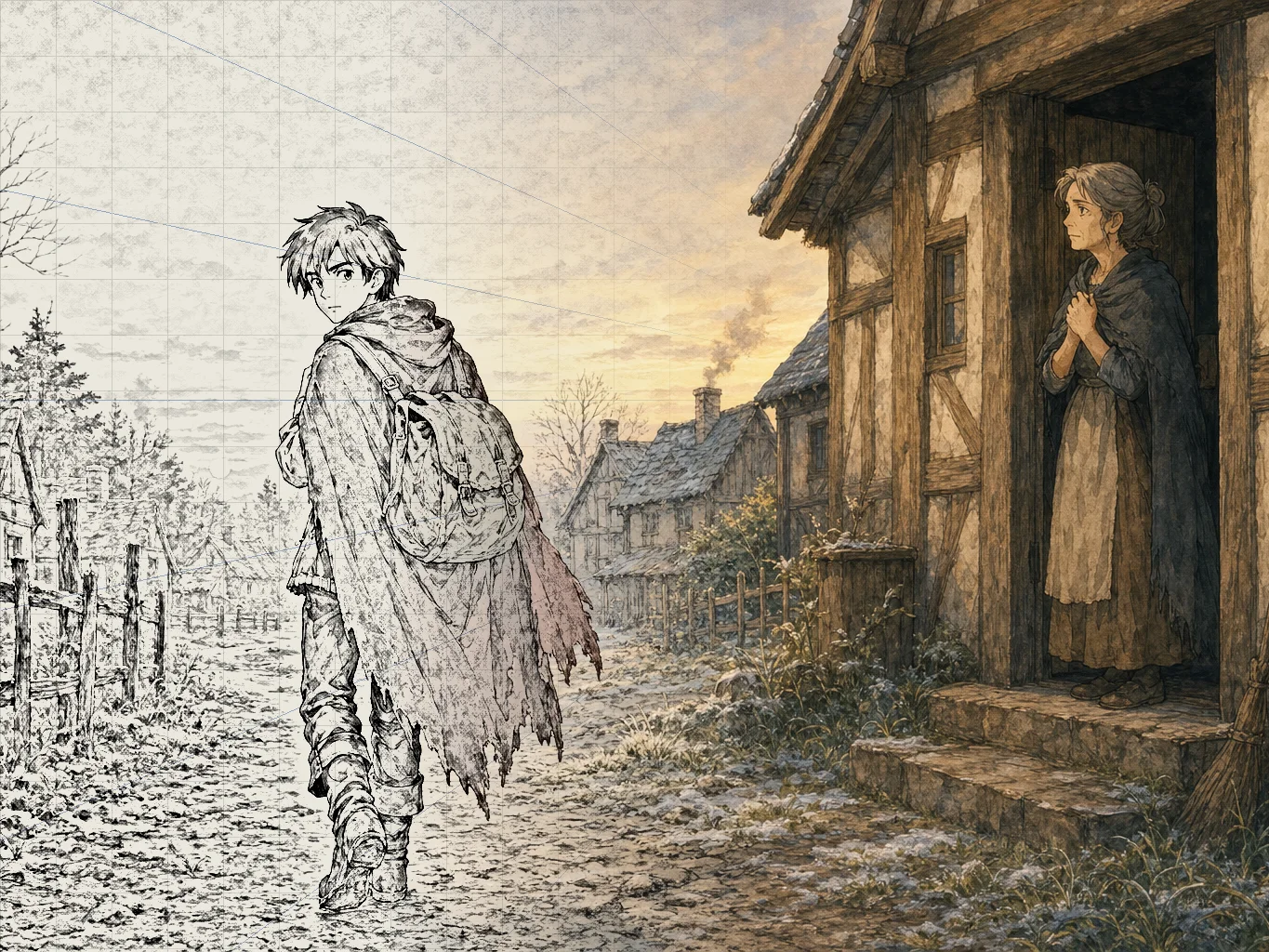
She packed the way she did everything — without fuss, without ceremony, with the quiet efficiency of a woman who has decided that if a thing must be done, it will be done well.
A canvas sack, the good one, with the leather straps that did not chafe. Bread — a full loaf, still warm, wrapped in cloth. “You used to eat your weight in this when you were knee-high,” she said, not looking up. “Garlen and I thought you’d come up hollow.” Cheese. Dried meat from the larder, the kind that kept for weeks. A waterskin, filled from the well. A spare shirt, rolled tight. A wool blanket, the heaviest they owned, folded into a square so precise it might have been measured. A knife — not the kitchen knife but the one Garlen kept on his belt, the one with the bone handle that he had carried since before Emrys was born.
Emrys looked at the knife. “Garlen, I can’t take—”
“You can,” Garlen said. “You will.”
His voice left no room for argument. He pressed the knife into Emrys’s hand. His fingers closed around the boy’s — firm, deliberate, the same grip as the shoulder-squeeze but longer, harder. It carried the full weight of everything Garlen could not say and would not try to.
He let go. His eyes went past Emrys, to the wall above the hearth, and lingered there, and then his mouth set in the particular way it set when a decision had finished making itself in him. He crossed the room — favouring the knee, as he always did — and reached up, and his hand closed on the hilt of the old sword that had hung there since before Emrys had memory. It came down with a thin grey rasp of dust. He held it out.
“My father’s,” he said. “He was a Guard. I was meant to follow him.” He turned the sword in his hand. “Life decided otherwise. It might be a thing for the road.”
Emrys took it. The grip was smooth where Garlen’s father’s hand had worn it; Garlen’s hand had not.
“I cannot wield it,” Emrys said.
“Few can the first time. Carry it. You’ll learn it.”
He stepped back. He returned to the table. He put on his glasses again. The list lay where he had set it.
The packing took less time than it should have. A life’s worth of belonging reduced to a single sack, slung over one shoulder. Emrys stood in the kitchen with the weight of it against his back and looked at the room he had grown up in — the worn table, the scrubbed floor, the cold hearth, the chair by the door that was his, had always been his, the column of pencil notches climbing the back-room doorframe — and the room looked back at him as rooms do when you are seeing them for the last time.
Mirna stood by the door. She had her arms crossed, not in anger but as people cross their arms when they need to hold themselves together.
“East?” she asked.
He had not told her which direction. He did not know how she knew.
“East,” he said.
She nodded once. Then she stepped forward and put her arms around him, and the embrace was not gentle. It was fierce and tight and it compressed the breath out of him, and she held on for longer than she ever had, and her shoulders shook once — just once — before she steadied herself.
Then the heat came.
It rose out of him without warning, faster than he could think, and he had no idea how to stop it. It bloomed off his skin, and the sword took it — Garlen’s old steel, slung across his back where her forearms crossed — and gave it back as light, a dull amber waking along the blade.
Mirna felt it before she saw it. She pulled back — and the blade over his shoulder was glowing.
He braced for the fear. It did not come. Her eyes moved from the glowing steel to his face, and she did not look away.
She raised her hand and laid it against his cheek. No flinch. No question. Her thumb moved once across his cheekbone.
The heat left him. The blade dimmed, and the steel went grey.
Her eyes were bright but dry. She smoothed the front of his shirt, adjusted the strap of the sack on his shoulder, tucked a loose thread into the seam of his collar.
“Remember what I told you,” she said.
No fire burns forever. Even the brightest ones must rest.
He nodded. He did not trust himself to speak.
Garlen was at the table, his back to the room, his glasses on, his list in front of him. He did not turn around. He did not say goodbye. But his hand, where it rested on the table, trembled, and the list was upside down, and Emrys understood that this was Garlen’s way of surviving the moment — by pretending it was not happening until the door closed and pretending was no longer needed.
Emrys opened the door. The morning air met him, cold and bright and indifferent, smelling of frost and woodsmoke and the faint cold breath of the hills.
He stepped through. He did not look back. If he looked back he would not leave, and he had to leave, and that certainty was the heaviest thing in the sack on his shoulders.
The door closed behind him.
Windward Hollow was barely awake.
Smoke rose from a handful of chimneys. A dog trotted across the lane with something in its mouth. The baker’s window was lit, the first in the village to light each morning, and the smell of bread drifted through the cold air with the particular cruelty of ordinary things continuing in the middle of extraordinary ones. Emrys walked fast. The sack bounced against his back. The cold air scoured his face and his lungs and seemed to scour the inside of him too — a clean, indifferent cold that stripped everything down to the essential, until there was only the sound of his boots on the frosted earth and the steady forward push of the road.
He passed the well where Darrin held court. Empty now. He passed the Thane barn, the forge, the storehouse where the smith kept his tools and his grievances in equal measure. He passed the ruin of the Ashworth cottage — still roped off, still breathing its thin, persistent smoke — and he did not slow down, but he looked, and looking once was enough, and the blackened timbers held his gaze as a wound holds a scar: silently, permanently.
At the edge of the square stood Darrin.
The baker’s son was outside, carrying a sack of flour from the storehouse to the shop. His back was to Emrys. His shoulders moved with the steady, mechanical rhythm of someone doing a job they have done a thousand times and will do a thousand more, and for an instant Darrin was not the boy who had called him a charity case, not the boy who had frozen outside the Ashworth fire, but simply a boy carrying flour for his father on a cold morning — a boy with a place and a name and a life that fit him, doing the work that was expected of him, rooted in a way that Emrys had never been and might never be.
Then Darrin turned. His eyes found Emrys — the sack on his shoulders, the set of his jaw, the direction he was walking — and something moved across his face — not a smirk, not a sneer, but something else, something that arrived too quickly for Emrys to read and was gone before he could try. Darrin opened his mouth. Closed it. The flour sack hung from one hand.
They looked at each other across the empty square, and the distance between them was twenty yards, and the distance between them was everything.
Emrys gave a single nod. Small. Barely a motion. The kind of acknowledgment you offer someone when there is too much to say and no language that can hold it. Darrin did not nod back. But he did not look away either.
Emrys turned and walked on. The square fell behind him. The lane narrowed to a path, and the path led south toward the meadow, and the meadow opened in a sweep of frosted gold. He carried Darrin’s stare with him into the cold — the held gaze, the unfinished question in it.
Marginalia
No notes yetOther readers’ notes are open for you to read. To leave one of your own — or to react to someone else’s — request full access.
No notes here yet.