Chapter 5
Aelios in the Ashes
The cottage was gone, but the foundation remembered.
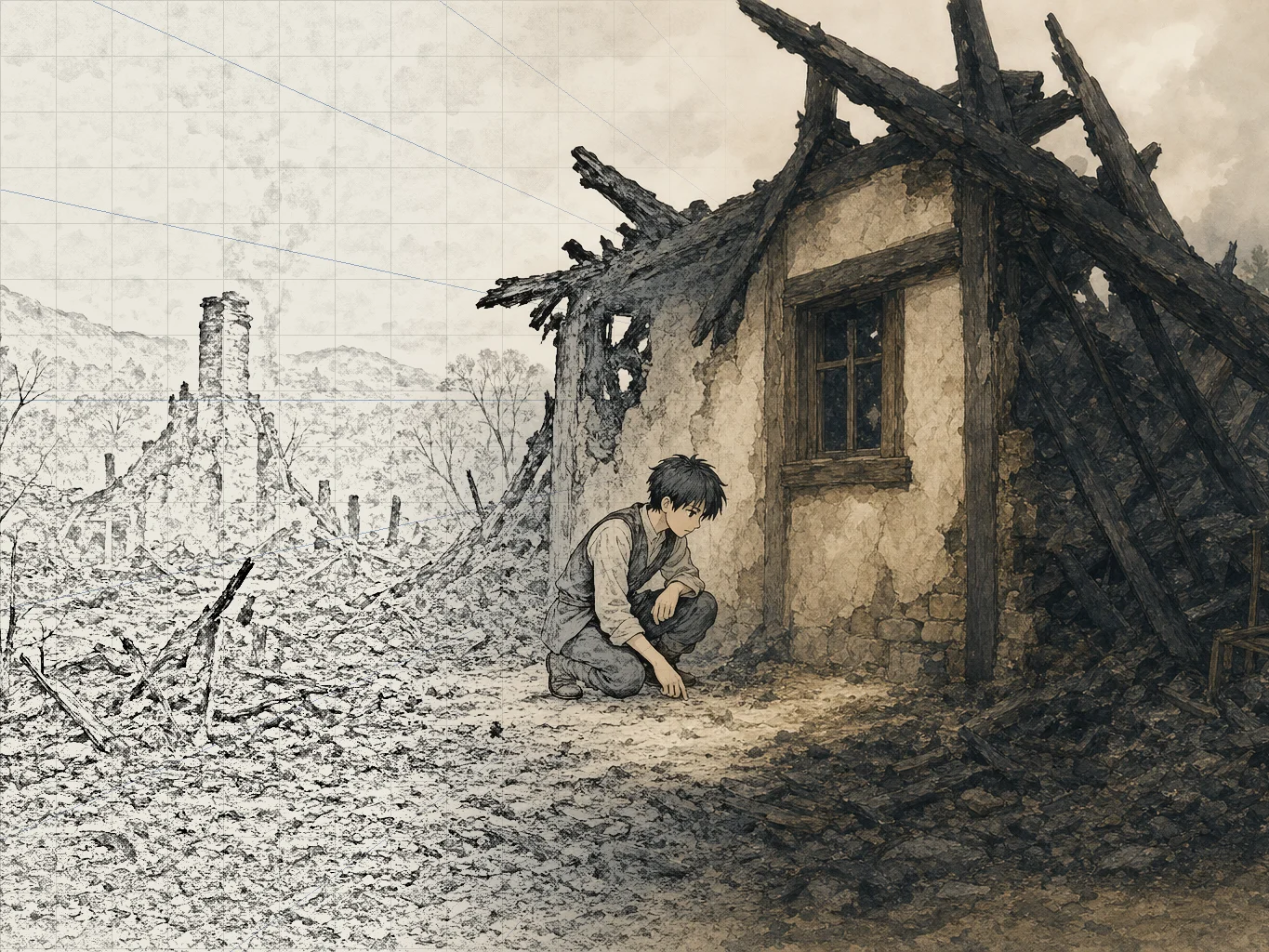
Aelios Ashworth stood in what had been the kitchen, or the room that served as a kitchen, because the Ashworths had not been the kind of family that had separate rooms for separate purposes. The walls were gone. The roof was gone. The second floor, where he had huddled in a corner while the world burned, was a jagged ledge of blackened timber and exposed joists that ended abruptly in air. What remained was the stone floor, the iron grate where the stove had sat, and the foundation walls — knee-high, soot-streaked, still warm in places when you pressed your palm to them, as though the stone had absorbed enough heat in one night to last for weeks.
He crouched to set his palm against the warm stone. A beetle crawled onto it from the soot — black, slow, the kind that hunted in ash. It stopped six inches from his hand and did not move on, did not retreat. The segments of its legs went still. Aelios watched it. Then his mind returned to the question of the fire’s design, and when he straightened the beetle had not moved.
He came here every day. His mother took it for grief. His father moved through the rebuilding with the grim, mechanical focus of a man who needed a hammer in his hand to keep from falling apart. The neighbors took it for shock. None of these explanations were correct, but all were close enough that no one questioned him, and not being questioned was, for the moment, the most important thing.
He was not grieving. He was thinking.
The fire had not behaved the way fire behaves. He had known this since the night it happened, with the kind of certainty that arrives not through reasoning but through experience. He had been upstairs. The fire had been everywhere — walls, ceiling, floor, the air itself turned to heat and light and choking, acrid smoke. He should have been dead.
The room had been consumed around him, every surface giving itself over to the blaze. And yet the corner where he sat had been untouched. Not merely survivable. Untouched. The flames had stopped at a line that ran, as near as he could remember, in a rough semicircle around the place where he sat, and they had held it like a guard holding a perimeter — not retreating, not advancing, simply maintaining a boundary that no one had drawn but that the fire respected absolutely.
He had turned this over every day since. He had turned it over the way his mind demanded he turn everything over: systematically, from multiple angles, testing each facet for consistency. And the conclusion his mind kept arriving at — the one he could not dismiss, no matter how many times he approached it from a different direction — was that the fire had not spared him by accident. It had spared him by design.
The question was whose design.
Because if the fire knew not to touch him, then either the fire was intelligent — which was absurd, which was the kind of thinking that belonged in the village stories he had outgrown by the age of ten — or something had told it. Something had held the boundary. Something had drawn the line and said: not him.
And if something had drawn the line around Aelios, then perhaps the same something had parted the flames for Emrys Rowan as he walked through the corridor. Or perhaps not. Perhaps there were two forces, two sources. Or perhaps — and this was the conclusion that returned to him most often, the one that sat in his mind like a splinter he could feel but not reach — perhaps the fire had not moved because of Emrys at all. Perhaps the fire had moved because of Aelios. Because the fire knew him. Because whatever intelligence held the boundary around his corner also cleared the path through the corridor, not to let Emrys in but to let Aelios out.
He did not have enough data to choose between these possibilities. But the shape of the last one fit the evidence in a way that the others did not, and the fitting troubled him, because it meant that the boy the village called a hero might have been, without knowing it, a passenger in a rescue that the fire itself had orchestrated.
He knew Emrys was gone before anyone told him.
It was the morning after the stranger’s visit — the man in the ash-coloured cloak who had appeared at the Rowan cottage and departed in the night, leaving behind a village that could not quite agree on whether he had been real. Aelios had watched the stranger arrive from the ruin of his cottage, where he often sat after dark, alone with the warm stones and his thoughts. He had seen the man cross the square with the unhurried gait of someone who knows exactly where he is going and does not require directions. He had seen Emrys open the door. The conversation had been too far — too much wind — but he had watched the stranger leave with the air of a man whose message had been delivered and received, and Aelios had gone to sleep.
In the morning, the window of the borrowed room showed Emrys walking east with a sack on his shoulders.
Emrys had changed since the fire. Anyone could see it, if they were looking, and Aelios was always looking. The way Emrys carried himself had shifted — not the steady, quiet competence that the village knew, but something beneath it, a tautness, the posture of a boy bracing against something that was pressing outward from the inside. He walked faster than he used to. He took the long way around the Ashworth ruin, adding minutes to his route rather than pass the blackened timbers. His hands, even after the bandages came off, moved differently — carefully, deliberately, as though he were aware of them in a way he had not been before, as though they might do something if he stopped paying attention.
And his eyes. The eyes had changed most of all. They had always been watchful — the eyes of a boy who observed the world with a patience that most people mistook for shyness. But now the watching had an edge to it, a wariness that had not been there before the fire, as though the threat he was watching for had gotten closer and he was no longer sure he wanted to find it.
Now Emrys was walking east with a pack on his shoulders and the stride of someone who was not coming back, and Aelios watched him disappear into the tree line and understood, with the same cold clarity he understood everything, that the stranger had given the boy a direction, and the boy had taken it, and the questions Aelios carried were walking away from him at the pace of a fifteen-year-old with long legs and nothing to lose.
He sat on the edge of his bed and stared at the wall and turned it over for a very long time.
Aelios’s question was mechanical.
How does this work?
Not what is the fire. Not why did it spare me. But how. What is the mechanism? What are the rules? If the fire held a perimeter around him, what force drew the boundary? If the Valarcan Sky was connected to the fire — as the timing suggested, as the old legends insisted — then what was the sky doing, precisely, when the stars rearranged, and where was the mechanism housed, and could it be measured, and could it be understood? Windward Hollow could not answer these questions. The village had no books, no instruments, no tradition of systematic inquiry. It had stories — the Valarcan Sky, the Etherborn, the Fracture — but the stories were folklore, worn smooth by generations of retelling, the edges rounded, the details lost, the uncomfortable specifics replaced by comfortable generalities. The stories said the Etherborn were destroyers. They did not say what the Etherborn were made of. The stories said the Valarcan Sky was an omen. They did not say what the omen measured.
Aelios needed measurements. He needed texts. He needed the kind of systematic, centuries-deep accumulation of knowledge that exists only in places built to gather it.
Everyone in Veridion knew of such a place. Every child knew the name, spoken with a mixture of awe and distance, like the names of mountains people will never climb: the Capitol. The great colleges. The observatories. The libraries that held texts from before the Fracture. Everything Aelios needed was there, behind walls he had never seen, in a city that was weeks of walking from the hills where he had spent his entire life.
He did not tell his parents.
The decision was not casual, and it was not painless. He loved his mother with the precise, complete certainty of a mind that did not waste energy on ambiguity. He respected his father — the quiet, solid man who had rebuilt half the village’s fences and could not rebuild the one thing that mattered. But love and respect were not the same as permission, and Aelios knew, with the pragmatic clarity that governed everything he did, that permission would not be given.
Sera had nearly lost him once. She would not willingly let him walk out of her sight. The conversation would be long and painful and it would end with him staying, and the staying would be its own kind of fire — slow, airless — and it would consume the questions as the blaze had consumed the curtains, and by the time it was done there would be nothing left of the boy who needed to know.
So he packed in the dark.
A change of clothes. His leather satchel. A sheaf of handwritten notes — observations he had made in the days since the fire, recorded in the careful, precise hand that his teachers had praised and his mother had found unsettling. A loaf of bread from the borrowed kitchen, wrapped in cloth. A handful of coin, saved over months from work he had done for the mill and the forge and anyone else who needed a sharp mind and steady hands.
He sat at the desk. The candle was already burning. He did not recall striking it, but the small detail was not the kind of thing that detained him on a night he intended to spend in motion.
He wrote the note last. It was the hardest part — harder than the packing, harder than the planning, harder than any of the mechanical, solvable problems that his mind was built to handle. Because the note required something his mind was not built for: it required him to say something true in a language that would not destroy the person reading it.
*Mother, Father — *
I have gone to find answers. I need to understand what happened, and I cannot do that here. I am not in danger. I am not running. I am doing the only thing I know how to do, which is to look for the truth until I find it.
I am sorry I did not tell you. I knew you would stop me, and I knew you would be right to, and I could not bear to hear it.
I will write when I can.
Your son,
Aelios
He set the note on the table, beneath the cup his mother always used in the morning, where she would find it first thing. He stood in the doorway of the borrowed room and looked at his parents sleeping — his mother curled on one side, his father’s arm across her, the pose of two people who had held each other through the worst night of their lives and had not yet let go — and he did not look long, because looking was dangerous, and he was not a boy who allowed danger to linger.
He left before dawn. The village was dark. The lane was empty. His boots made no sound on the frosted earth, or if they did, the sound was small, and the village had larger things to listen for.
He passed the ruin of their cottage. The foundation walls were pale in the starlight, the ash and soot washed grey by the cold air. A candle — someone’s candle, left in a lantern on the fence post beside the ruin, a marker or a memorial, one of those small village gestures that serve no practical purpose and mean everything — guttered as he passed. The flame bent sideways, shrank to a blue nub, and then recovered slowly, as though the candle had briefly forgotten how to burn and had needed a moment to remember.
Aelios did not notice. He was already past it, already moving, his mind three steps ahead of his body the way it always was — calculating the distance to the trade road, the days of travel ahead, the questions he would ask when he arrived at a place that could answer them.
Behind him, the candle steadied, and the village slept, and the ruin of the Ashworth cottage sat in its foundation, a wound the village had not yet learned to bury.
The trade road ran west from the Windward Hills, through country that Aelios had never seen.
He walked. The cold did not bother him — not because he was hardy but because it barely reached him, his attention so thoroughly occupied by the interior machinery of his thoughts that the exterior world registered only as a series of problems to be solved: where to sleep, what to eat, which fork in the road led in the right direction and which led deeper into the hills. He solved them one by one, with the efficient, untroubled competence of a mind that had been solving problems since it was old enough to recognise them. The landscape changed slowly — from the close, familiar hills of Windward Hollow to rolling farmland, then to wider, flatter country where the road straightened and ran for a time beside a wide slow river, brown and high with the autumn rains, and the traffic increased. Carts drawn by oxen, slow and heavy in the autumn mud. Merchants with dogs trotting at their wagon wheels. Wanderers heading west toward towns Aelios had never heard of. People who asked where he was from and accepted “east” as an answer.
He listened more than he spoke. That was his way. In the inns where he stopped for water or warmth, he sat quietly and let the conversations wash over him. A fiddler scraped in the corner of one inn, a singer worked another, the same road-worn tunes passed from house to house; Aelios let the music pass and turned back to the talk, which was all about the same thing: the Valarcan Sky. Everyone had seen it. Everyone was afraid. Everyone had a theory.
A farmer outside a town called Drennick told him the sky had moved because the world had grown spoiled — spoiled by cities that had grown too large, spoiled by people who had forgotten the old ways, spoiled as the world is always spoiled in the stories of people who need someone to blame for things they cannot control. A merchant’s wife in the same town said it was simpler than that: the Etherborn were returning, the way they always returned, because the world was a wheel and the wheel had turned, and the best anyone could do was bar the doors and wait for it to pass. A blacksmith’s apprentice, young and loud and drunk on fear, said the Etherborn should be hunted down and killed before they could break the world again, and the table around him agreed, and the agreement was ugly and loud and absolute, and Aelios took it in and said nothing.
The Etherborn. Destroyers. Monsters. The thing the world feared most, and the thing the world understood least.
And what if I was inside their fire?
The thought slotted into place beside the others he had gathered, waiting to be connected. He had been in the fire. The fire had known not to touch him. The boy who pulled him out carried burns that should have dropped him and kept walking. The Valarcan Sky had appeared on the same night. The village legends said the Etherborn were tied to fire, to water, to earth, to air. He did not have enough information to draw a conclusion. He was a boy with a handful of observations and a mind that refused to stop processing them. But the shape of the question was forming, and the shape pointed toward the place where the observations might, at last, meet the pattern that could hold them.
He walked west. The trade road widened. The traffic thickened. And somewhere ahead — weeks ahead, beyond hills and farmland and the flat, industrious sprawl of the lowlands — the answers waited.
Behind him, far to the east, a boy named Emrys Rowan walked into the Emberwood with a pack on his shoulders and no answers at all.
Two boys from the same village. Two directions. Two questions, shaped by the same fire, aimed at the same truth, arriving by different roads.
Neither of them looked back.
Marginalia
No notes yetOther readers’ notes are open for you to read. To leave one of your own — or to react to someone else’s — request full access.
No notes here yet.