Chapter 4
A Knock in the Night
The day after the Valarcan Sky, Windward Hollow did not so much wake as reluctantly admit that morning had come.
From the window of his room, where he had been sitting since the small hours with his blanket around his shoulders and his back against the wall, dawn arrived grey and diffident, as though it, too, were unsure of its welcome. Somewhere a dog barked once and was hushed. Frost had come in the night, riming the edges of the windowpane and turning the lane outside into a pale, glittering stripe between the dark shapes of the cottages.
Then, one by one, doors opened. Figures emerged — hunched, cautious, scanning the sky before committing to the open air like swimmers testing a current with one foot before wading in. Emrys watched the old neighbour woman cross the square with a water pail, her free hand shading her eyes against a sun that was not particularly bright. The baker’s boy, Darrin, appeared briefly in his father’s doorway and then retreated, pulled back inside by a hand Emrys could not see. Old Aldric Thane stood at the edge of his fence for a full five minutes, staring eastward at the line of the hills, his white beard catching the light, his expression unreadable at this distance.
The sky was ordinary. That was the worst part. It was an unremarkable autumn sky — high, pale, faintly marbled with cloud — and its ordinariness was a lie.
Mirna did not ask him how he had slept. She set bread and cheese on the table and busied herself with small tasks — sweeping the already-clean floor, refolding linens that did not need refolding — and the sound of her broom against the flagstones was the only conversation the cottage seemed able to manage. Garlen came and went twice without explanation, his jaw set in the particular way it set when he was thinking hard about something he did not intend to share.
Emrys ate. He tasted nothing. The hum in his chest — the wire-taut vibration he had carried since the Emberwood — had not faded with sleep, because he had not slept. It sat behind his breastbone like a second pulse, faint but insistent, and every time he had nearly forgotten it, it reasserted itself with a small, interior throb that said: I am still here.
He spent the day doing things that did not need doing. He mended a fence post that was cracked but not broken. He carried water from the well to the kitchen, four trips instead of the necessary two, because the walking helped and the cold air gave him a sensation that was not the hum. A raven sat on the well-post, watching him with one flat eye, and did not move when he drew the bucket. He split kindling from the wood he had gathered the day before, his bandaged palms complaining with every stroke of the hatchet, and the pain was a relief because it was specific and explainable and had a cause he could point to and say: that. That is why I hurt.
The village moved around him in its own state of numbed industry. People did their chores. They spoke to one another in short, practical sentences — pass the bucket, hold the gate, mind the step — and avoided the longer conversations that might lead to the topic on all their minds, and one none of them knew how to discuss. Sera Ashworth stood outside the ruin of her cottage, among the blackened timbers, with Aelios beside her, his face still carrying the grey, hollowed look of someone who has breathed too much smoke and slept too little since. Sera had one hand on the back of his neck, as one holds on to something precious in a current, and the look on her face was a kind of bewildered exhaustion, as though she had been handed too many terrible things in too short a time and her arms were simply full.
As Emrys passed, Aelios’s gaze found him. It was the same look from the night of the fire — that dark, steady attention that sat wrong in a boy’s face, too still, too knowing — and the hum in his chest shifted, a subtle dissonance, like a note changing when a second instrument enters slightly out of tune. He looked away first. He always looked away first. But the feeling followed him down the lane, pressing at the base of his skull like a headache that had not yet arrived.
He wanted to speak to Sera. He did not know what he would say. And he did not want to stand near Aelios again — not because the boy had done anything wrong, but because the wrongness was not in anything Aelios did. It was in what came over Emrys when he was near him, and he could not explain it.
Later, on one of his trips to the well, he passed Darrin sitting alone on the bakery step. No friends flanking him. No smirk. Just a boy sitting with his elbows on his knees, watching the ruined Ashworth cottage from across the square with an expression that Emrys recognised because he had seen it in his own reflection: the particular, private look of someone replaying a moment they wish they could undo. Darrin did not see him pass. Or if he did, he did not have the energy to perform.
Emrys walked on. He said nothing. But the image stayed with him — Darrin alone on the step, stripped of his audience, looking at the place where he had been asked to be brave and hadn’t been — and it settled beside the other uncomfortable truths he was collecting, another stone in a pocket that was getting heavy.
By evening the village had drawn itself in again, cottages sealing up against the dark with the grim efficiency of a body closing a wound. A dog whined somewhere to be let in, and from the Emberwood an owl started its long, low call — the night’s watch beginning, the day creatures no longer welcome. Emrys sat in his chair by the door — his chair, always — and watched the last light drain from the sky through the gap in the shutters, and the sky did nothing unusual, and the relief he expected to feel did not come.
Mirna lit a candle. Not the hearth. She had not lit the hearth since the night of the fire, and no one had remarked on it, and the candle threw a small, careful circle of light that reached the table and the stove and no further, and the rest of the cottage sat in shadow.
Garlen was the first to go to bed. He squeezed Emrys’s shoulder as he passed — a firm, deliberate pressure, the kind of gesture that substitutes for a speech — and disappeared into the back room. Mirna stayed up a while longer, sitting across from Emrys with her mending in her lap, her needle moving in and out of a stocking with the automatic precision of someone whose hands know the work well enough to do it without the rest of her.
They did not speak. The candle guttered. The cottage ticked and settled around them as old houses do, joints cooling, beams contracting, a language of small sounds that Emrys had known all his life and that tonight was a stranger’s voice speaking a familiar tongue.
Emrys glanced at the hearth. The dark mouth of it sat against the far wall like an accusation — cold, unlit, the iron grate still holding the pale ghost of old ash. He had not asked Mirna to stop lighting it. She had simply stopped, without announcement, reading the shape of his discomfort like a sailor reading the shape of weather.
He swallowed. “Mirna.”
“Mm.”
“You can light the hearth. If you want. It’s cold enough.”
He aimed for easy. Offhand. The kind of thing a person says when they truly do not mind either way. But the words came out with a stiffness he could hear, and he knew Mirna could hear it too, because her needle stopped.
She did not look up. Her fingers rested on the stocking, the needle poised mid-stitch, and the silence between them had turned careful — the silence of two people standing on either side of something that has never been spoken aloud.
“Emrys,” Mirna said.
“It’s fine. Really. I don’t—”
“I know you fear the flame.”
The words arrived in the room without weight or judgment, simply, as fact, as though she were saying the sky is grey or the bread is done. But they landed in Emrys like a fist. His throat closed. Heat rose in his face. And beneath the heat, something else. Relief. The dizzying, nauseating relief of being seen in a place you have spent your whole life trying to be invisible.
He opened his mouth to deny it. For the first time, he could not.
He said nothing. That was answer enough.
Mirna set the mending aside. She rose from her chair, and the movement was slow and deliberate. She crossed the space between them and sat on the arm of his chair, which she had not done since he was small, and the nearness of her — the smell of flour and wool and the faint sweetness of the chamomile she drank every evening — loosened something in his chest that he had not known was clenched.
“I have watched you sit in this chair since you were old enough to climb into it,” she said. Her voice was low, not a whisper but something adjacent to one — the register people use in rooms where someone is sleeping. “And I have watched you watch that hearth like a person watching a door they expect something to come through. You have never said a word about it. You have never had to.”
Emrys’s vision blurred. He blinked it clear, furious with himself.
“How long have you known?” he asked.
“Since always.” She said it without weight, without pity. “A mother knows. Even one who came to it the way I did.” The candle flame trembled between them. Mirna looked at the hearth, then back at him, and her eyes held something larger than comfort and steadier than reassurance, something that had been waiting, perhaps, for this exact moment to be said.
“Don’t be afraid,” she said. “No fire burns forever, Emrys. Even the brightest ones must rest.”
The words settled over him like a blanket drawn up to the chin. He did not understand them. But they reached him. They reached him like the first warmth of spring through a window you have kept shut all winter.
Mirna touched his hair. She let her hand rest there a moment longer than usual, her fingers light against the crown of his head, and then she rose, and the chair arm where she had been sitting was still warm, and she crossed the kitchen, and she paused at the doorway to the back room.
“You should sleep,” she said.
“I know.”
She went to bed, and the cottage was his.
The knock came an hour later.
It was not a loud knock. That was the first strange thing about it. People in Windward Hollow knocked the way they did everything else — plainly, without pretense, a good solid rap that announced itself and expected an answer. This was different. Three taps, evenly spaced, quiet enough that Emrys might have mistaken them for the house settling if they had not carried a quality of intention that wood contracting against the cold simply did not possess.
He sat very still. His heart stuttered in his chest.
Three taps again. Same rhythm. Same restraint. Patient.
He stood. The floorboards protested under his weight, and he crossed the kitchen in four careful steps and put his hand on the latch. The iron was cold. He could feel the night on the other side of the door — its depth, its silence, the particular density of air that has been cooling for hours with nothing to warm it.
He opened the door.
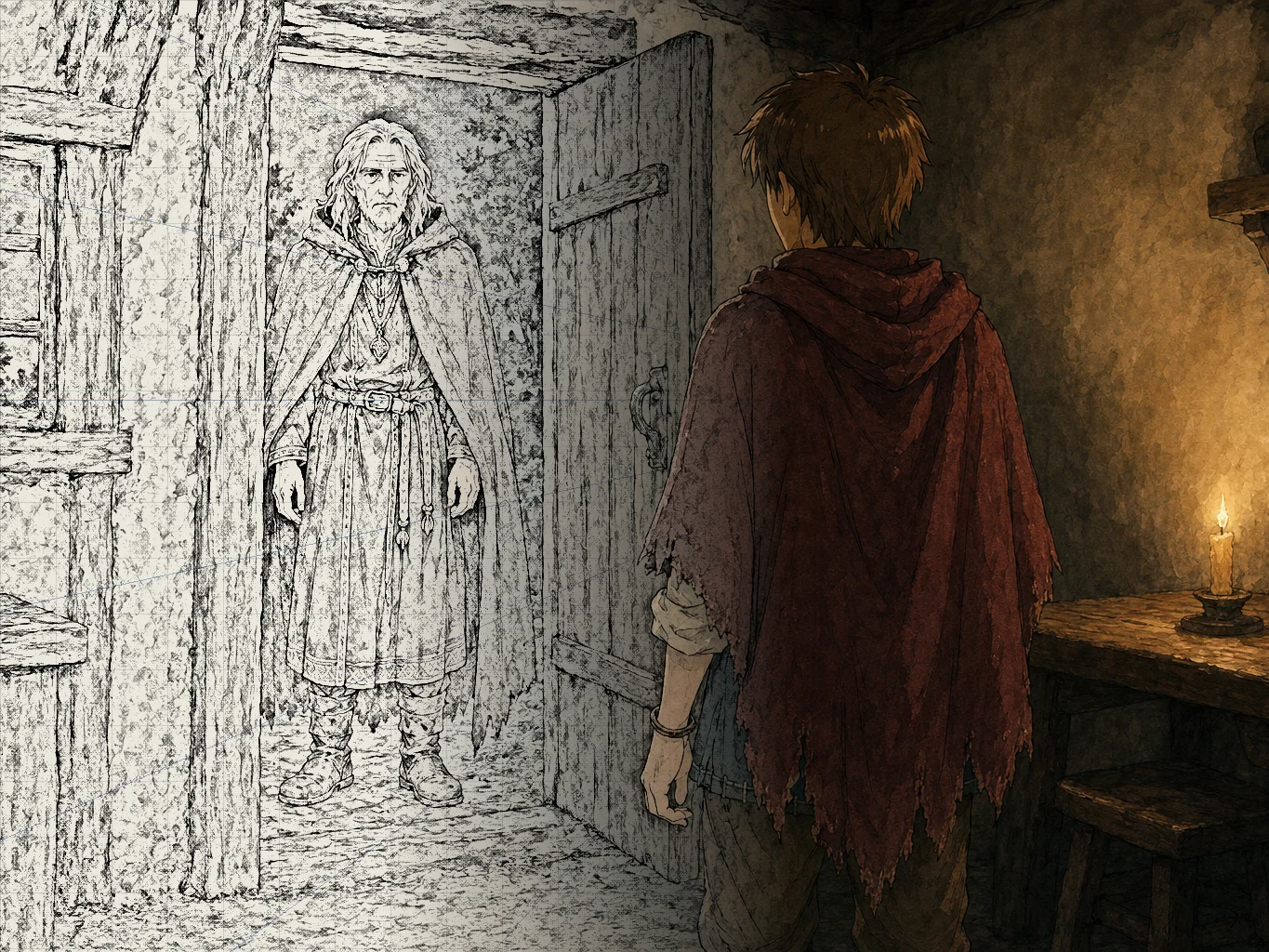
The man standing on the threshold was tall as certain old trees are tall — not dramatically, not imposingly, but with a settled, rooted quality that suggested he had been that height for a very long time. His face was narrow and deeply lined, the skin weathered to the colour and texture of walnut bark, and his eyes — when they found Emrys in the doorway — were the grey of weathered hill stone, steady and unhurried and so profoundly settled that looking into them was like setting hands on bedrock. His hair was dark still, dark as a far younger man’s, but for a single ashen streak above one temple — the colour leached from it, not the grey of age but something the years did not account for. And beneath the stillness of his eyes, something the stillness held closed: a cold that had got into him somewhere and stayed.
He wore a travelling cloak of dark wool, road-stained at the hem, and beneath it a tunic of deep green, neither fine nor poor but simply functional. A leather satchel hung from one shoulder. His boots were old and well-made and caked in a strange reddish mud, fine-grained and unfamiliar, the colour of no soil Emrys had ever turned with a spade. He carried no weapon that Emrys could see, and no lantern, and yet he stood in the dark of the Rowan doorstep as though the dark were a room he had been given a key to long ago.
He looked at Emrys as the stars had looked at Emrys — with recognition. But where the sky’s attention had been vast and impersonal and terrifying, this was something else. This was specific. This was a man who had come a long way to stand on this particular doorstep at this particular hour, and who was not surprised by what he found there.
“You felt it,” the man said.
His voice was low and unhurried, carrying an accent unlike anything in Emrys’s memory — a cadence that rounded certain vowels and softened others, the speech of a man from somewhere far beyond anything Emrys knew.
Emrys’s mouth was dry. “Who are you?”
The man did not answer the question. He looked past Emrys into the dark kitchen, then back, and the faintest suggestion of something — not a smile, not quite, but the architecture of one — moved across his weathered face.
“May I come in? The cold is honest but unkind, and I have been walking since before your village could put a word to what it saw last night.”
Every sensible instinct Emrys possessed told him to close the door. Windward Hollow did not receive strangers easily at the best of times, and these were not the best of times, and there was a strangeness to this man that went deeper than his unplaceable accent and his road- muddied boots. But the hum in Emrys’s chest did something it had not done before. It steadied. It eased, fractionally — a held note easing as a second voice joined it in harmony.
He stepped aside. The man entered.
They sat at the kitchen table in the candlelight, the single flame throwing their shadows large and wavering against the walls. Emrys did not offer tea. The man did not ask for it. He set his satchel on the floor beside his chair and folded his hands on the table, and his hands were like his face — weathered, patient, marked by the kind of use that does not diminish but deepens, like a river deepening a channel.
“You have questions,” the man said.
“I have a hundred questions.”
“Then you are wiser than most, who arrive at this moment with certainties.” The man’s grey eyes rested on him with a quality of attention that was neither warm nor cold but simply thorough, like the attention of someone reading a document they have waited a long time to receive. “I will not answer them. Not tonight. That is not why I am here.”
“Then why are you here?”
“Because you sat in the dark instead of sleeping, and you have been sitting in the dark for two nights now, and the sitting will not help you, and the dark will only grow.”
The words landed in Emrys’s chest, one at a time. Each one stayed.
“The sky,” Emrys said. “Last night. The stars. You know what it was.”
“I know what your village thinks it was.”
“The Valarcan Sky. Aldric Thane said—”
“Aldric Thane knows a name. A name is not the same thing as knowledge, any more than a map is the same thing as the land it describes.” The man tilted his head, studying Emrys with a patience that belonged to stone. “You felt something, when the stars moved. Describe it.”
Emrys opened his mouth. Closed it. The memory of the Emberwood pressed against the inside of his skull — the pressure, the hum, the terrible moment when the sky had seen him and something inside him had answered — and the words he reached for fell short of it, every one.
“I don’t know how,” he said.
“Yes,” the man said. “That is the right answer.” He leaned back in his chair. The wood creaked beneath him with the small, settled sound of old timber taking a weight it had been built to take.
“I am not going to tell you what you are,” the man said. “That is not something that is told. It is something that is found.”
“That’s not helpful,” Emrys said, and the frustration in his voice surprised him.
The man’s mouth moved again — that same almost-smile, an expression that lived more in the rearrangement of lines around his eyes than in the lips themselves. “No. It is not. Helpful would be a warm bed and a clear morning and a life that asks nothing extraordinary of you. I cannot offer you any of those things.”
“Then what can you offer me?”
“Direction.”
The word sat between them on the table like a coin placed down in payment.
“You cannot stay here, Emrys.”
The sound of his own name in the stranger’s mouth jolted him. He had not given it. The man read the alarm in his face and raised one hand — a slow, calming gesture, the kind you might use with a horse that has caught a scent it does not like.
“I know your name because I have always known it. That is all I will say on the matter, and it will have to be enough.”
“It’s not enough.”
“No,” the man said. “It never is. But consider what you already know, even if you have not yet admitted it to yourself. The fire at the Ashworth house. The way the flames behaved. The sky, and what you felt beneath it. The thing in your chest that has not been quiet since.” He paused. “You know that you are not what this village believes you to be. You have known it longer than you have had words for the knowing.”
Emrys said nothing. His hands were clenched in his lap, the burned skin of his palms pulling tight over the fists.
“The answers you need are not here,” the man continued. “They cannot be found in Windward Hollow.”
“You want me to leave.”
“What I want is irrelevant. What matters is that the leaving must be yours. It must come from your own legs and your own will, or it means nothing.”
“Leave and go where?”
“East,” the man said. “Toward the places where the land remembers what the people have forgotten. That is all I can tell you and more than I should.”
The candle guttered. For a moment the kitchen went dark, and in that darkness the hum in his chest flared — a brief, bright pulse, like a plucked string finding its true note — and when the flame steadied again the man was watching him with an expression that, for the first time, held something warmer than composure. It might have been sadness. It might have been recognition. It was difficult to tell with a face that practised.
“Mirna and Garlen,” Emrys said. The names hurt to speak, as though they had grown hooks. “They took me in. They raised me. I can’t just—”
“You can tell them that you are going to look for your family.”
The sentence dropped into the room like a key into a lock. “Your origins have always been a question in this house,” the man said, and his voice was careful now, each word placed with the deliberation of someone laying stones in a wall. “Mirna has wondered. You have wondered. It is the one lie that will carry the weight of truth, because it is close enough to the truth that you will not have to pretend when you say it.”
“It’s still a lie.”
“Yes.”
“And you won’t tell me why.”
“I will tell you this.” The man leaned forward, and the candlelight caught his eyes and held them, and in that light they were not grey at all but something older and stranger — the colour of stone that had forgotten what it had been laid down to remember. “The road will ask things of you that you are not prepared for. You will want to turn back. There will be times when turning back is the wisest, safest, most reasonable thing you could do, and you must not do it. Not because the world demands the sacrifice of these things, but because the thing inside you that answered the sky will not let you rest until you understand what it is. You can ignore it. You can bury it. But it will find you, Emrys. It has already found you.”
He paused. Something shifted in his expression — a weighing, a decision — and then he said, more quietly: “And know this: you are not the only one the sky moved for. Nor do you have the years your kind once had to find them.”
The words hung in the room. Emrys did not know what to do with them. His mind went to the Valarcan Sky — the vast, world-spanning pattern — and wondered, for the first time, how many had carried what he had carried beneath it.
He stood. The chair scraped softly against the floor. He retrieved his satchel, slung it over his shoulder, and moved toward the door with the quiet, inevitable motion of a man who has said exactly what he came to say and does not intend to linger over the silence that follows.
At the threshold he stopped. He did not turn around. “When the time comes,” he said, “you will know what you are. Not because someone has told you, but because the knowing has always been there, waiting for you to stop being afraid of it.”
And then he opened the door. He stepped through it like a man stepping onto familiar ground — without checking his footing, without looking down, without the small adjustments most men make for darkness. The night received him, and he was gone.
Emrys sat at the table for a long time after the door closed.
He was thinking about Mirna’s hands. The quick, careful way she brushed the hair from his face each morning, as if to check he was still there. The way she had gripped his arm in the square after the Valarcan Sky — tight, trembling, the grip of someone holding on to something they are afraid of losing. He was thinking about Garlen’s shoulder-squeeze, firm and wordless, a gesture that carried everything the man could not say and did not try to. He was thinking about the word the stranger had given him, sharp-edged and simple as a blade.
Direction.
You can ignore it. You can bury it. But it will find you.
The candle went out. The kitchen settled into true dark — the deep, textured dark of a house at rest, full of the small sounds of sleeping people and cooling stone and the particular silence that wood makes when the last warmth of the day has left it. Emrys sat in that dark and let it hold him.
Tomorrow he would have to find the words. He would have to sit across from Mirna and Garlen at the table where the stranger had sat, and say the thing that was not quite a lie and not quite the truth.
I need to find my family.
The words formed in his mind like breath on cold glass — visible, fragile, already beginning to fade. He turned them over. He tested their weight. They were the right shape.
He hoped.
He rose from the table. He crossed the kitchen in the dark, navigating by memory — three steps to the stove, two more to the hallway, four to his door. His room was cold. The blankets were where he had left them, bunched against the wall from his sleepless vigil the night before. He pulled them to the bed and lay down and stared at the ceiling, and the ceiling stared back at him, low and blank, and the hum was steady and quiet and waiting, and the night outside was vast, and somewhere to the east the land held the answers that the old man had promised and refused to give.
Sleep came slowly, in thin, reluctant layers, like frost forming on glass. It took him under by degrees. The last thing he was aware of was the silence of the cottage — the deep, fragile silence of a house gone down into sleep.
Marginalia
1 noteOther readers’ notes are open for you to read. To leave one of your own — or to react to someone else’s — request full access.
Loved by Pablo