Chapter 3
The Valarcan Sky
Three days after the fire, the Ashworth cottage was still smoking.
Not in any dramatic way — not the thick, choking billows that had swallowed half the lane that night — but in thin, persistent threads that rose from the rubble at odd hours, as though the ruin could not quite accept that it was finished burning. The village had roped it off with twine strung between fence posts. Children were told to stay clear. Dogs circled the perimeter with their ears flat and their tails tucked, unwilling to cross some invisible threshold that the twine only pretended to mark. Crows had settled on the nearest rooftops, black and hunched, watching the wreckage with the unhurried interest of creatures that knew how to wait.
Emrys avoided it entirely. He took the long way around the village square each morning, lengthening his walk to the pasture so that he would not have to pass the blackened timbers or the place where the garden wall had crumbled into a heap of sooty stone. If the detour drew notice, no one mentioned it. People were being careful with him these days — the wary care of folk who have not decided whether he is brave or simply strange.
His hands were healing — Mirna had dressed the burns with comfrey and honey and changed the linen twice a day without comment — but the new skin on his right palm still pulled whenever he made a fist.
It was Garlen who told him about the kindling.
“We’re low,” he said at breakfast, spooning porridge into a bowl and sliding it across the table. “The Ashworths’ store went up with the house, and the smith lent out half of ours before the fire. I need someone to go to the edge of the Emberwood and cut a load. Deadfall, mostly — there’s plenty of it along the southern tree line this time of year.”
He said it casually, but his eyes rested on Emrys a beat too long.
“I’ll go,” Emrys said.
“Your hands—” Mirna began.
“Are fine.” He flexed them under the table where she could not see. The pull of new skin was sharp, but manageable. “I can swing a hatchet. I’ve done it with worse.”
He had not done it with worse. But the cottage pressed close these days — the walls too near, the hearth too present, even unlit. A restlessness in him needed the distance that the forest offered: the open air, the cold, the sound of wind moving through branches instead of voices moving through rooms.
Mirna looked at Garlen. Garlen looked at the porridge. Some negotiation passed between them in silence, conducted in the private language of people who have shared a home long enough to argue without speaking.
“Take the good hatchet,” Garlen said. “And be back before dark.”
The path to the Emberwood led south from the village, past the sheep meadow and the stone wall that marked the boundary of the Thane farmsteads, then up a long, gentle slope of open grassland where the wind had nothing to stop it and came at him sideways, like a dog that wanted to play. Emrys walked into it with his shoulders hunched and the hatchet tucked through his belt and the canvas sack slung over one shoulder, and the cold did him good — clean and unambiguous, the opposite of fire. A ridge-hawk circled high above the hill crest, sharp-eyed and unhurried, its shadow crossing the meadow in long, patient sweeps.
The grass here was the colour of old rope, dried out by autumn and flattened where deer had bedded down; their trails cut faint trampled lines through the meadow, converging on the tree line ahead, where the Emberwood began in a dark, ragged wall of oak and ash and hornbeam. The forest had been old when Windward Hollow was young — everybody said so — and the air beneath its canopy was different: cooler, stiller, carrying a smell of loam and rot and something green and faintly mineral, like a stone pulled from a riverbed.
Emrys had always liked the edges of the Emberwood. The deeper reaches were another matter — there were stories about those, told low around hearths, of ruins and lights and sounds that belonged to no animal anyone could name — but the southern tree line was safe enough, close to the open meadow, where he could still see the sky, and the deadfall there was plentiful: branches brought down by autumn storms, dry enough to split clean.
He found a good spot where a large ash had shed a limb sometime during the last storm. The branch lay across the forest floor like an arm flung out in sleep, its bark already beginning to peel in long, papery strips. Emrys set the canvas sack against a root, unwedged the hatchet from his belt, and began to work.
The rhythm of it was a relief. He had not known how badly he needed something simple and physical, something that asked nothing of him but the same motion over and over. Lift, swing, crack. The hatchet bit into the dry wood and it came apart in neat pale sections, and the clean, decisive snap of it was the most honest sound in days. No one was watching him out here. No one was being careful with him. The trees did not care what he had done the night before.
He worked until his shoulders ached and the sack was half full, and then he sat on the fallen limb and rested, breathing hard, his burned palms throbbing with a dull heat that was not entirely unpleasant. The sun had moved while he worked. It hung lower now, caught in the bare branches above him like a copper coin dropped into a nest of twigs, and the light it cast was long and amber and heavy with the melancholy of late autumn afternoons, when the world seemed to hold its breath before letting go of something it could not keep.
He was about to stand and finish the job when it came.
It began in his chest.
Not pain — not exactly. A pressure, like something pressing outward against his ribs from the inside, as though his lungs had forgotten their proper size and pushed to expand beyond the space allotted to them. He put a hand to his sternum and held it there, and the pressure did not ease. It was the same feeling from the burning corridor of the Ashworth house — that moment when the flames had bent and something deep inside him had answered — but slower now, wider, less like a spark and more like a tide.
He looked up.
The sky had changed.
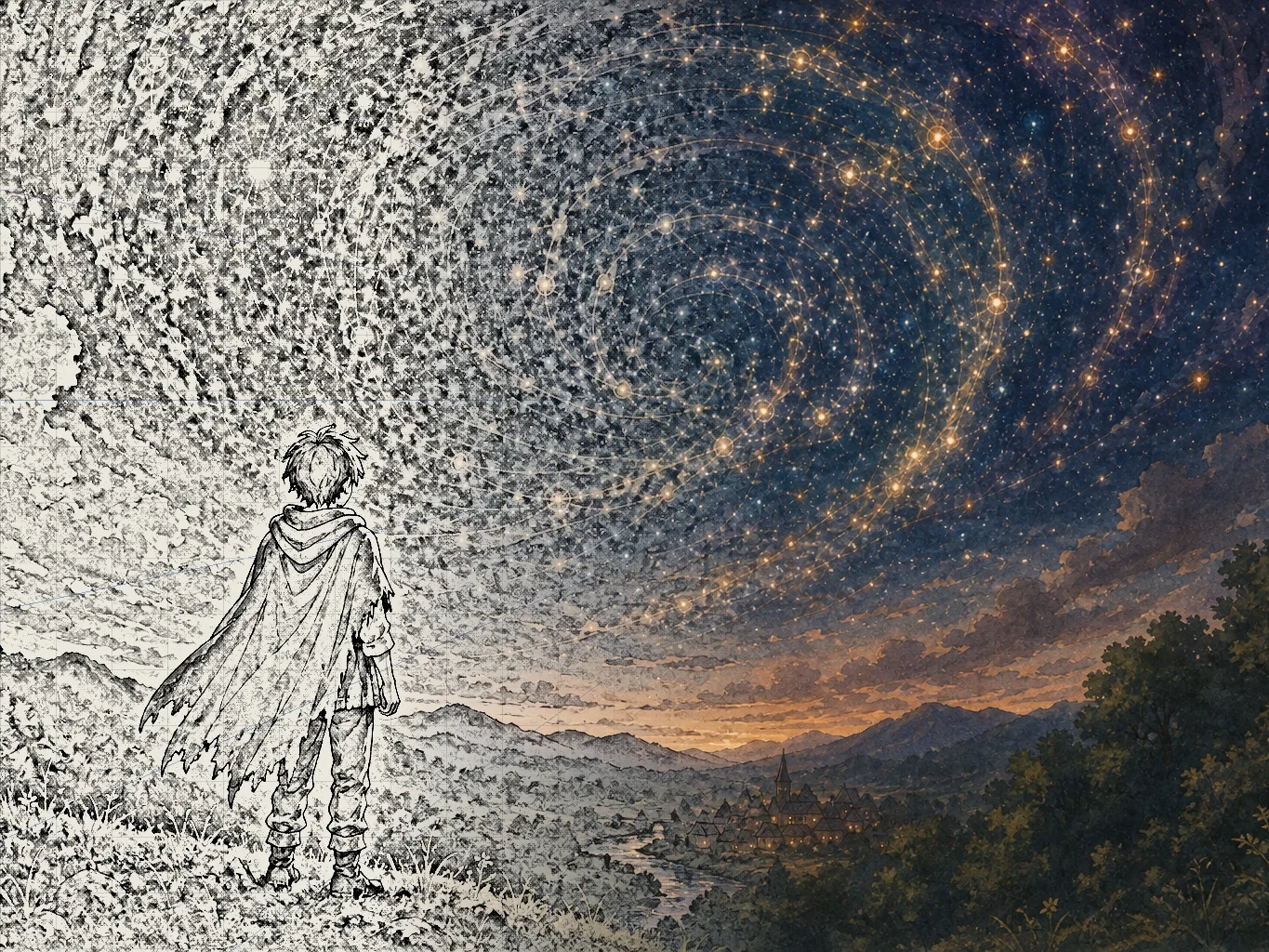
It happened without sound, without warning — quietly, while he was bent to the wood. The sun was still there, still caught in the branches, but it had dimmed somehow, as though a veil of gauze had been drawn across it. And above the dimming, in the blue-grey vault of the sky, the stars were coming out. Stars, in the middle of the afternoon.
Emrys stood. The hatchet slipped from his fingers and landed in the leaves with a sound he did not hear. He could not look away. The stars were not simply appearing — they were moving, drifting across the sky with a slow, deliberate grace that had nothing to do with the ordinary wheeling of the heavens. They were rearranging themselves. Clustering. Drawing together into shapes less like constellations than like letters in an alphabet he could not read but somehow knew.
The pressure in his chest tightened. His breath came shallow and fast. The trees around him were utterly still — not a branch moved, not a leaf stirred — and in that stillness the forest listened, as a hall listens when the last note of a song has faded and the silence that follows is not empty but full, brimming with the echo of what has just been said.
The stars settled.
They formed a pattern unlike anything Emrys had seen before: a vast, wheeling arrangement that spanned the sky from horizon to horizon, bright as forge-sparks, each point of light connected to the next by faint threads of luminescence that pulsed once, twice, and then held steady. It looked like a door — not a door with hinges and a handle, but the idea of a door, rendered in light, pressed against the inside of the sky from the far side.
And then the sky looked back.
He could not have explained it to anyone. There were no eyes, no face, no shape that his mind could fix on and say, there, that is what looked at me. But something in the arrangement of those stars carried an awareness so vast and so alien that it struck him like a wave striking the shore — not with malice, not with kindness, but with a force that simply did not account for the smallness of what stood before it. And beneath that — beneath the enormity of it, the terrible impersonal scale — there was something else. Something that bent toward him. Not toward Windward Hollow, not the Emberwood, not the wide world beneath the burning sky, but the boy standing alone among the trees with his burned hands and his hammering heart. It reached for him as the fire had reached for him in the Ashworth corridor: with recognition.
It knew him.
Emrys’s knees buckled. He caught himself on the fallen branch, both hands gripping the bark, and the new skin on his palms split and bled and he did not notice. The pressure had become a sound — not a sound for his ears but one that rang in his bones, a low, resonant hum. The hum filled him. It pressed against the walls of his body like water against a dam, testing for weakness, looking for the place where it might pour through.
For one instant — one bright, annihilating instant — the barrier gave.
Something opened inside him. Not all the way. Not enough for whatever lay on the other side to come through. But enough for him to feel the edge of it: a heat that was not heat, a vastness that had weight, a presence so old it belonged to the age of bedrock.
And then it closed.
The stars dimmed. The threads of light between them flickered and faded. The pattern held for one more breath — that enormous, sky-spanning door — and then it began to dissolve, the stars drifting apart, returning to their proper places or vanishing altogether, sinking back into the blue-grey afternoon as though they had never been there at all. The sun brightened. The wind returned. A crow called from somewhere deep in the Emberwood, a sharp, ugly sound that broke the silence like a stone breaking a window, and Emrys heard his own breathing — ragged, desperate, the breathing of a man held underwater who has only just found the surface.
He looked down at his hands. His palms were bleeding. The bark beneath them was scored with pale scratches where his fingers had dug in. He was shaking — not the exhausted way he had shaken after the fire, but from the inside out, as though his body had been struck like a tuning fork and was still ringing at a frequency he could not hear.
He stood there for a long time, not moving, not thinking — or rather, thinking one thing, over and over: What was that. What was that. What was that.
No answer came. The forest was only a forest again. The sky was only a sky.
Emrys wiped his hands on his trousers, leaving dark smears on the cloth. He picked up the hatchet. He loaded the rest of the kindling into the sack with mechanical, unthinking motions, like a body continuing a task after the mind has left it, and he slung the sack over his shoulder, and he turned, and he walked back toward the village.
The grass of the open meadow was gold in the late light. The wind pushed against him. At the edge of the tree line, a crow sat on a low branch — the same one that had called a moment ago, or a different one, he could not tell. It was facing the wrong direction. Not outward, toward the meadow and the light, but inward, toward the deep forest, and it was still — utterly, unnaturally still, its feathers darker than a crow’s feathers should be, as though the black had deepened. It did not react when he passed. He looked back once. The crow had not moved.
His shadow stretched out behind him, long and thin, reaching back toward the Emberwood as though some part of him had been left there.
He knew something was wrong before he reached the square.
The sounds were off. On an ordinary autumn evening Windward Hollow had a particular music to it — the clang of the smith’s hammer at the forge, the laughter of children chasing each other between the houses, the low conversational hum of people going about the last business of the day. What reached Emrys now was none of that. It was quieter and louder at the same time: quieter in the way of voices that have dropped to whispers, louder in the way of doors being shut and bolts being thrown and the particular, unmistakable scrape of heavy furniture being dragged across floorboards.
The village was closing itself up. Not against the cold. Against something else.
He came around the corner of the Thane barn. The square was full of people. Not the usual kind of fullness — not the loose, purposeful movement of market day or the rowdy clumping of a festival crowd. These people stood still, or nearly still, gathered in tight clusters of three and four and five with their arms crossed and their shoulders drawn in and their faces turned upward. They looked at the sky.
Emrys looked up with them, though he already knew what they had seen.
The stars were gone. The sky was ordinary again — grey and deepening toward evening, tinged with the last amber of the setting sun. But the memory of what had been there hung over the village like smoke, visible in how people held themselves: tense, guarded, afraid.
No one was going to tell them that.
“It’s the Valarcan Sky.”
The voice came from the cluster nearest the well — old Aldric Thane, the patriarch of the largest farmstead, a man whose age had bent his back but not his opinions. He stood with his thumbs hooked into his belt and his white beard jutting forward and his eyes bright with a certainty that Emrys found, in that moment, more frightening than anything the Emberwood had given him.
“It’s the Valarcan Sky,” Aldric said again, louder this time, as though repeating it might force the words to make sense. “You learned the rhyme at your mother’s knee, same as I did.” His voice dropped into the flat singsong of a thing recited since childhood:
When the heavens turn and the star-gate wakes,
down come the four the old age makes;
we set them the feast and we called them kind —
and ash was all they left behind.
The certainty in him was the certainty of children chanting what they do not understand. “The stars rearrange. They form the gate. And the cursed ones come.”
Silence. Then a woman’s voice — the old neighbour woman, by the sound of her — thin and tight: “The Etherborn.”
The word moved through the crowd like a stone through still water. Emrys watched it happen. He watched faces change. He watched arms tighten around children. He watched Darrin’s father, the baker, take an involuntary step backward as though the word itself might burn him.
“The world-breakers,” someone murmured. “The ones who shattered the sky.”
“That was centuries ago,” another voice said — younger, uncertain. “Surely it’s just—”
“Just what?” Aldric turned on the speaker with the swift precision of a man who has been waiting to be challenged. “Just a trick of the light? Just a story? You saw what I saw. You all did. The stars moved. They formed the pattern. The old signs are the old signs, and they don’t come for nothing. The sky remembers.”
The crowd murmured. It was close to agreement — not quite there. Fear has a gravity of its own, and Aldric Thane was heavy with it, pulling the lighter doubts into his orbit. Emrys could feel the shift happening as he watched: the moment when a crowd of frightened individuals became a single frightened creature, moving and thinking as one.
He lowered his gaze before anyone could catch him watching, and without deciding to, drew his bandaged hands up into his sleeves, out of the light.
Across the square, near the ruin of the Ashworth cottage, Aelios stood apart from his mother, apart from the crowd, his face turned upward. The sky was ordinary again — grey and fading — but Aelios was still looking at the place where the stars had been, and the expression on his face was not fear. It was focus. The narrow, intent look of someone committing something to memory. Emrys watched him for a moment, unsettled, and then Mirna’s hand found his arm and pulled him away. Her face was composed, but her hand, when she took his arm, was trembling.
“You saw it,” she said. It was not a question.
“Yes.”
She looked at him — really looked, the kind of look that goes past the surface and checks the foundation — and whatever she found there made her grip tighten.
“Come inside,” she said. “Now.”
They walked home through a village eating itself with whispers. Fragments reached him as they passed — snatches of conversation pulled taut as wire, voices pitched too low for the words to carry but high enough for the fear behind them to bleed through.
“…the end of the world…”
“…my mother said it would come in our time…”
“…what do we do now?”
The whispers were not about him. They were about the sky, and the legends, and the old fear that had lived in the bones of every village since the sky first broke. But Emrys took them in, and they turned inward, and found the place where his own questions lived — the ones he had been carrying since the fire, since the corridor, since the moment the flames had bent around him as if they had been waiting for him.
The fire. The Ashworths. And now this.
Nobody in the square was drawing a line between the fire and the sky. Nobody was looking at him. But Emrys was drawing the line himself, alone, in the private dark of his own head, and the line was straight and it connected everything — the parting of the flames, the reaching of the stars, the hum that had not stopped since — and the picture it made was a picture he did not want to look at. What if I’m connected to this?
The thought was his own. It was not whispered by a villager or spoken by an elder or written in any legend.
His mind went to the people Windward Hollow had quietly forgotten — the ones who had been different in ways the village could not explain; and what the village could not explain, it could not forgive.
Nobody was pointing at him. Not yet. But if they knew what was in him — if they knew what the fire had done in the corridor — if they knew the hum—
He walked faster. Mirna kept pace without asking why.
The Rowan cottage was dark when they reached it. Garlen had not lit the hearth — whether by choice or forgetfulness, Emrys could not tell. The three of them stood in the kitchen in the thin grey light, and no one spoke for a long moment, and the silence was not the comfortable kind.
Garlen broke it. “All right?” he asked, and the single word carried more weight than a longer question would have — the shorthand of a household that had learned to say hard things in small ones, or not at all.
“All right,” Emrys said.
He set the sack of kindling by the door. He put the hatchet on its peg. He sat in his chair — the one nearest the door, the one he always chose — and looked at the cold, empty hearth, and let himself think the word the villagers had been whispering in the square. Etherborn.
He did not know what it meant. Not yet. But the word sat in him the way his fear of fire had always sat in him — low and old and certain — and for the first time in his life, the fear had a shape.
Outside, Windward Hollow bolted its doors and shuttered its windows and told its children to stay inside. The night came on, starless and cold, and the village waited, and the night only made it worse.
In the Rowan cottage, Emrys sat in the dark and did not sleep, and the place inside his chest where the sky had opened and the fire had answered hummed like a wire pulled taut — quiet, persistent, impossible to ignore.
Waiting.
Marginalia
1 noteOther readers’ notes are open for you to read. To leave one of your own — or to react to someone else’s — request full access.
Loved by Pablo