Chapter 2
Hungry Dark
Sleep would not come, and long after the cottage had gone quiet around him Emrys gave up on it and went back down to the front room.
The hearth still held a low fire — wood settling, flame whispering — and shadows shifted across the walls like shapes that could not decide where to rest. He sat on the low stool with his forearms braced on his knees, watching the flames the way a man watches a dog he does not trust. He did this often, and had never been able to say why. Fire unsettled him at a level beneath reason, too deep in the body to argue with. The light was beautiful, almost cheerful — and beneath the beauty there was appetite, a patient, sleepless hunger that never quite closed its eyes.
Tonight the heat seemed sharper, pressing at his skin as though the hearth were testing the distance between them. A log shifted with a pop; embers sprayed up the chimney like startled insects, and he flinched — a small, involuntary jerk he hated even as it happened. He curled his fingers into fists until the knuckles whitened, as though that might make him braver.
Why do you always do this to me? The thought rose unbidden, and at that exact moment the flames snapped, leaning and brightening as though they had heard it. You pretend to be tame, he thought, and risked another glance. But I see what you really are.
For as long as he could remember, fire had made him feel watched. The rest of Windward Hollow used it and forgot it — warmth for winter, a pot set to simmer; for him it had always held something else, a will that was not his own and did not answer to his. His body leaned away before his mind could argue. Only a fire, he told himself. A pile of burning wood. But it was never nothing.
“Emrys?”
Mirna’s voice pulled him out of it. She stood in the doorway in a shawl caught over her nightclothes, her hair loose, awake at an hour she had no business being — the tired lines at the corners of her eyes cut deeper tonight than the day could account for.
“You should be in bed, dear,” she said. But she did not say it as though sleep were the thing on her mind.
“So should you.”
Something near enough to a smile, and tired. She lingered a moment, and he felt the shape of whatever she wanted to say press against the silence between them — a question, maybe, or a comfort she could not find the words for. Then she let it go, and went back down the hall, and the cottage was his again.
He sat a while longer, letting the fear settle in his chest like a stone lowered into deep water. He hated that it was there. It was weakness, and weakness was a thing the village marked. Windward Hollow did not like what it could not name.
A sharp shout sliced through the night and jolted him awake.
He had not meant to fall asleep on the stool. His head had slid against the wall; his limbs were heavy with the treacherous warmth that lulls a body into forgetting itself. He blinked, disoriented, until the shouting gathered meaning.
“Fire! Fire at the Ashworths’ house!”
The words hit like cold water. Emrys was on his feet at once, the stool scraping back across the flagstones. He wrenched the door open and the night air rushed in, biting and smoky, carrying a smell that was nothing like the hearth — sharper, wilder, laced with the acrid sweetness of burning thatch.
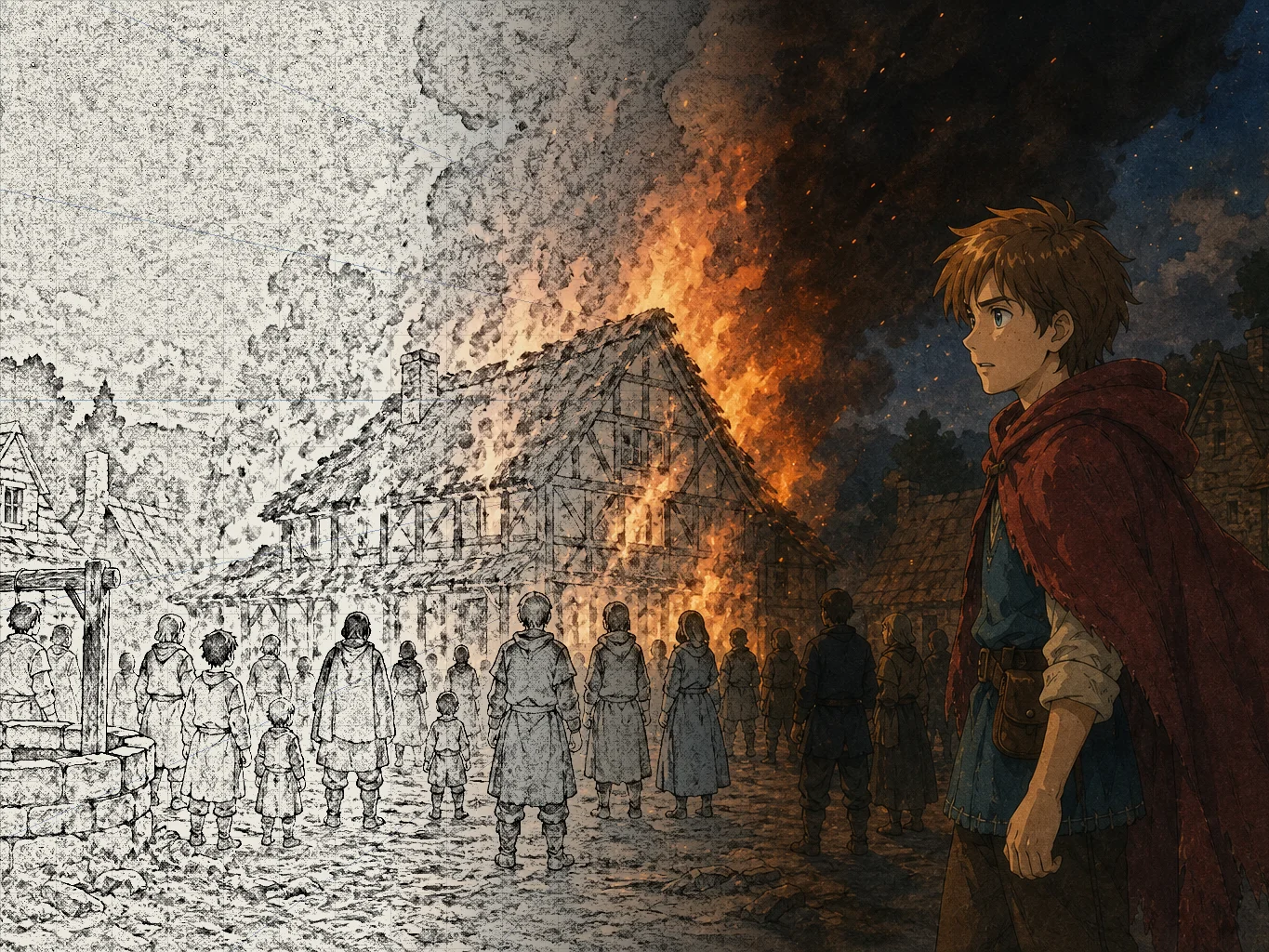
Across the village, a column of black smoke clawed at the sky. Orange light pulsed against the rooftops and the hard angles of timber frames, turning the familiar shapes of Windward Hollow strange and disordered, the whole village cast in a lurching red. The Ashworth cottage — near the village centre — was burning. Flames ran along the thatched roof as though the straw were soaked in oil, moving with a speed and hunger that had nothing to do with an overturned lantern or a careless ember.
Emrys took a step — and stopped. His eyes locked on the inferno, and his breath went very still. The fire roared like a living thing, its breath rolling out across the square in hot waves, flaming tendrils reaching upward as though trying to brush the stars. The hearth’s earlier snap flashed through his mind — that sly, testing pop — and he understood, with a certainty that bypassed thought entirely, that this was not a tame flame behind stone. This was what he had always known fire could become.
He forced himself forward. One step, then another. Each one cost him something.
Near the square the Ashworths huddled together — except one. Sera Ashworth’s face was streaked with tears and soot. She clutched her husband’s arm as though he were the only solid thing left in the world, and he sat slumped on a low wall, trembling, his skin grey beneath the ash.
“My son!” she cried, her voice breaking on the word like a branch that has held too long. “He’s still inside!”
The crowd faltered — a collective flinch, like a flock seeing a hawk. Sera turned wildly and seized the nearest people she could reach — Darrin and his friends, who stood at the edge of the chaos with buckets they had not lifted. Her fingers twisted in Darrin’s tunic.
“Please,” she begged. “You’re strong, you’re young — you can get to him. Please. He’s my boy.”
Darrin’s face drained of colour. He looked at the burning house, then at his friends, and Emrys, watching from across the square, saw the calculation move behind his eyes — the weighing of another life against his own.
“It’s too dangerous,” one of them said.
“We can’t,” another said, already stepping back. “It’s — it’s suicide.”
“Please!” Sera screamed, and the word seemed to tear at the fabric of the air itself.
Darrin hesitated — long enough to show he knew exactly what was being asked — and then he pulled his arm free of Sera’s hands and turned away. The others went with him. Not one of them looked back, and it was Darrin’s back Emrys watched the longest.
The grown men were past it — blackened head to foot, moving like ghosts, working in exhausted rhythm to keep the blaze from the next roof. Some had collapsed dragging the Ashworths from the door. No one else would go — Emrys could see it in them, the emptied and the soot-blind.
Then the boy cried out again from somewhere inside the burning house — thin, frightened, a sound so raw it made Emrys’s throat tighten until it hurt.
No one’s going to save him. The thought tasted like ash.
His fists clenched. Every part of him screamed to stay back — every instinct certain that to walk into that house was to die. And yet his feet moved. His body carried him toward the blaze as though it belonged to someone else — someone braver, or simply more desperate. Each step was heavy with dread. The heat grew brutal, pressing against his face with the flat, impersonal weight of an iron held too close.
At the door he wrapped his cloak around his forearm and shoved.
The door gave, and a wave of fire-breath and smoke surged out to meet him — not heat alone but a wall of superheated air that knocked him back a step as though the house itself were daring him to turn away. He gritted his teeth, steadied his feet on the scorched threshold, and drove on. Inside, the world was orange and choking. Flames devoured the walls with a greedy, crackling sound, almost conversational — the mutter of something talking to itself as it fed. The air was thick and pressing, heavy on his lungs, and each breath was a negotiation — a shallow, desperate draw filtered through the cloak he held across his face. Smoke stung his eyes until tears spilled without permission.
Do not think about it, he told himself. Not the noise. Not the heat. Not the way the fire seems to reach. Only the boy.
“Hold on!” he shouted, and his voice was already hoarse, scraped raw by smoke. “I’m coming!”
A faint wail answered — muffled, directionless, somewhere above him. He stumbled toward the stairs. The steps groaned under his weight, slick with soot, and the banister was hot enough to sting through his sleeve. Flames licked at his boots. He climbed through them, one riser at a time, into the roaring dark.
The upstairs corridor was a tunnel of smoke. Visibility ended at arm’s length. He followed the sound — that thin, terrified wail, growing louder now, pulling him forward the way a current pulls a swimmer who has stopped fighting it. At the end of the corridor he found a door, closed. The handle branded his palm through the cloth of his cloak. He turned it and shoved.
The boy was in the far corner of a small bedroom. Hot, yes. Thick with smoke. But the fire had not reached it. The room was consumed — bed frame, curtains, the wall behind the door — but that corner held, untouched, as though the blaze had simply overlooked it. The boy huddled with his arms wrapped around his knees and his eyes wide and shining in the firelight. He was about Emrys’s own age. The terror on his face was conscious — the sharp fear of someone who understood exactly what was happening.
“It’s all right,” Emrys said, though his own voice shook. He dropped into a crouch. “I’ve got you.”
He unwound the cloak from his arm and wrapped it around the boy, tucking the heavy fabric close — around his shoulders, over his head, across his face — until only his eyes showed. The boy gripped Emrys’s shirt with both hands and did not let go.
“Keep your face down,” Emrys said. “Don’t breathe unless you have to.”
He lifted the boy — heavier than he expected, solid and real and trembling against his chest — and turned back toward the corridor. The corridor was worse now. The fire had followed him up, and the passage that had been merely smoky when he came through was laced with flame, tongues of it running along the ceiling and dripping down the walls, bright and reaching.
He went anyway. There was no other way to go.
But as he stepped into the corridor with the boy pressed against his chest, the flames shifted. The tongues of fire along the walls bent back as he passed — not extinguished, not gone, but leaning away, like tall grass leaning from a hand drawn through it. The air was still brutal, still choking, but the bright edge of the fire drew back by inches, and the inches were enough. He did not stop to wonder why. His legs were moving and his lungs were burning and the boy was alive against his ribs and that was all there was.
The stairs crackled under his weight. Halfway down, the ceiling above the entrance gave way with a thunderous crash. Sparks rained down in a blinding shower. Emrys hunched over the boy, taking the sting of heat and falling ash across his shoulders and the back of his neck, and the pain was sharp and immediate in a way that cut through everything else — the fear, the smoke, the roaring — and left only the simple, ferocious need to keep moving.
Then — cool air.
He staggered out into the night, and the roar of the fire was swallowed by shouting voices and sudden, disbelieving cheers. The cold hit him like a second shock, and for a moment the world tilted and blurred, and he was aware of nothing but the boy’s weight in his arms and the ragged, beautiful sound of his own breathing.
Sera Ashworth surged forward. Emrys lowered her son into her arms as gently as his shaking body would allow, and the boy — Aelios — went to her without a sound, his face pressing into the curve of her neck. But in the instant before he turned away — in the half-second between Emrys’s arms and his mother’s — Aelios looked at him.
It was not gratitude. It was not relief. The boy’s eyes found his through the smoke and the firelight, and they held, and in that holding something struck him not in his mind but in the deep, unreasoning place where his fear of fire lived — a jolt, a tightening, as though a string he had not known was there had been plucked. Aelios’s face was blank with shock, but his eyes were not blank at all. They were dark and steady and too old for the face that held them, and they looked at Emrys the way the fire looked at him — as though they already knew him. With a question that had nothing to do with the fact that he had just been saved, and everything to do with something else entirely — something that preceded the fire, preceded the rescue, preceded both of them.
Then Sera pulled him close, and the look broke, and Aelios was just a boy again — shaking, burying his face in his mother’s neck.
Emrys stood there with his empty arms at his sides, and the place in his chest where the jolt had landed throbbed once, like a bruise being pressed, and then went quiet.
“Thank you,” Sera whispered into her son’s hair. “Thank you.”
Emrys could not find words. His lungs burned. His skin had drawn tight, as though the heat had shrunk it. Soot coated him like a second hide, and beneath it his hands throbbed with the kind of pain that arrives late and intends to stay.
The night dragged on. Buckets emptied. Shouts grew hoarse and then fell silent. At last the blaze was beaten down to smouldering ruin and glowing embers, and the Ashworth cottage was no longer a house but a memory of one — a skeleton of blackened timber and crumbling stone, still breathing thin threads of smoke into the cold air. Emrys stood at the edge of the crowd, watching the Ashworths cling to one another as though they might still be pulled apart by the dark. Aelios had not let go of his mother. She had not let go of him. They stood in the lane amid the wreckage and the ash, and the village moved around them in the careful, uncertain way that people move around grief they cannot fix.
“You saved him,” someone said nearby.
Darrin stood at the back of the crowd, apart from the others, his face unreadable. He had not moved from the spot where he had been standing when Emrys entered the house, and his eyes were not on Emrys but on the doorway — on the place where the fire had been.
Emrys made no answer. His body ached in ways he had not known a body could ache — deep, structural, as though the fire had reached past his skin and touched something underneath. But it was not the ache that weighed on him.
It was the embers.
He looked at the dying glow of the ruined cottage. The coals shifted and pulsed in the rubble, orange and red and the deep, secret colour that lives at the heart of a flame when it has burned so long it has forgotten everything except the burning. And in that shifting, pulsing light — for just an instant, so brief he could not be certain it had happened at all — something watched him. Not a face. Not a shape. But an attention, pressed against the other side of the heat like a hand pressed against frosted glass, and in the moment before it vanished it landed in his chest — a flare of recognition, quick and terrifying, as though the fire had looked at him and known his name.
His breath caught. The image was gone as quickly as it had come, leaving only the ember-light and the cold night air and the sound of his own heartbeat, too loud, too fast, filling his skull like a drum.
The strength went out of his legs all at once, like a rope going slack when the weight it holds is suddenly released. He crumpled to the ground, and the cold grass met him, and the sky above was full of smoke and stars.
Gasps rose from the crowd. Garlen pushed through and dropped to his knees beside him, gripping Emrys’s shoulders with both hands as though he could hold him in the world by force of will alone.
“Emrys! Lad, are you all right?”
Garlen’s voice sounded distant, muffled by the pounding in his head. Emrys focused on the face above him — the lined, weather-darkened features, the worry cut deep into the creases around the mouth — but the world would not quite hold still.
“I’m fine,” he whispered. “Just… tired.”
Garlen shook his head. His jaw worked, emotion getting the better of speech. “You’re more than fine, boy.” The words came rough, half-strangled. “You’re a hero.”
Emrys was no hero. He was a boy who had walked into a burning house because no one else would, and who had come out the other side carrying something heavier than the boy he had saved.
And in the strange, grey space between consciousness and collapse, his mind turned to Darrin — not with anger, not with contempt, but with something that unsettled him more: he had felt that same calculation, that same paralysis, the same terrible arithmetic. The only difference was that his feet had moved and Darrin’s had not, and he did not know why. You cannot blame a person for a fear you share.
As his eyes fluttered shut, one thought stayed: the fire had let him walk out. He did not know what that meant. He was not sure he wanted to.
Marginalia
1 noteOther readers’ notes are open for you to read. To leave one of your own — or to react to someone else’s — request full access.
Loved by Pablo