Chapter 1
Windward Hollow
“Off to save the world again, orphan boy?”
Darrin Ridgehawk and the two boys who trailed him everywhere were arranged around the old well at the bend in the lane in the loose, proprietary sprawl of people who have nothing to do and wish to be seen doing it. Broad-shouldered and ginger-haired, Darrin wore the easy confidence of a boy who had never once been asked to explain where he came from, and he had pitched the question to carry the length of the lane.
Emrys kept walking, the feed bucket heavy in his hand, his eyes fixed on the path.
“Hey — we’re talking to you!” one of the others shouted.
“What’s the matter?” Darrin said, smirking. “Too good for us now?”
“I’m busy,” Emrys said. Calm and flat, like a door closed without slamming.
“Busy pretending you’re one of us?” Darrin’s smile sharpened, finding its edge. “Face it, Rowan. You don’t belong here. No family, no name — you’re just a stray.”
Emrys did not let it show. He stopped, turned, and met Darrin’s gaze with an expression as steady as stone.
“You’re right,” Emrys said, and the words came out steadier than the boy who spoke them. “I don’t have what you have. But—” The right word stalled somewhere between his chest and his tongue. He held Darrin’s gaze. He waited. The word arrived a beat late, but it arrived. “I don’t have to make people feel small for it.”
Surprise flickered across Darrin’s face before he smothered it with a scoff. The expression lasted only an instant, but Emrys caught it — a crack in the performance, a glimpse of the boy behind the swagger who understood exactly what had just been said to him and did not like it.
“Whatever,” Darrin said. “Go play hero somewhere else.”
Emrys turned back toward the pasture. He kept his stride even, his shoulders straight, his face composed — the posture of someone who is fine, who has handled it, who is moving on.
He was not fine.
The morning had begun like any other.
Emrys woke to the sheep.
Their bleating came through the thin walls of the cottage as it came every morning — soft and complaining and insistent, the sound of animals who had opinions about the cold and intended to share them. Autumn had settled over Windward Hollow in the night, and the chill met him the moment he swung his legs from the bed, sharp as river water through his stockings and up through the soles of his feet where they touched the floorboards.
He pulled on his boots. The laces were stiff from yesterday’s damp. The room was small and dark and smelled of wool and the faint, woody sweetness of the timber walls, and beyond the window the sky was the colour of eggshell — pale and clean, giving nothing away about the day to come.
He stepped outside.
The cold was immediate and specific and good. Frost clung to the grass like powdered silver, and the air carried the smell of wet earth and fallen leaves and the faint mineral tang that drifted down from the hills to the north — a smell the village lived inside so constantly that most people had stopped noticing it, as one stops noticing the sound of a river after living beside it long enough. Emrys had not stopped noticing. The cold filled his lungs and sharpened everything: the edges of the fence posts, the thin lines of smoke rising from chimneys at the far end of the lane, the dark shape of the crow on its post at the bend — still there, still motionless, the dogs two cottages down already starting their morning’s argument with it. They would lose that argument too.
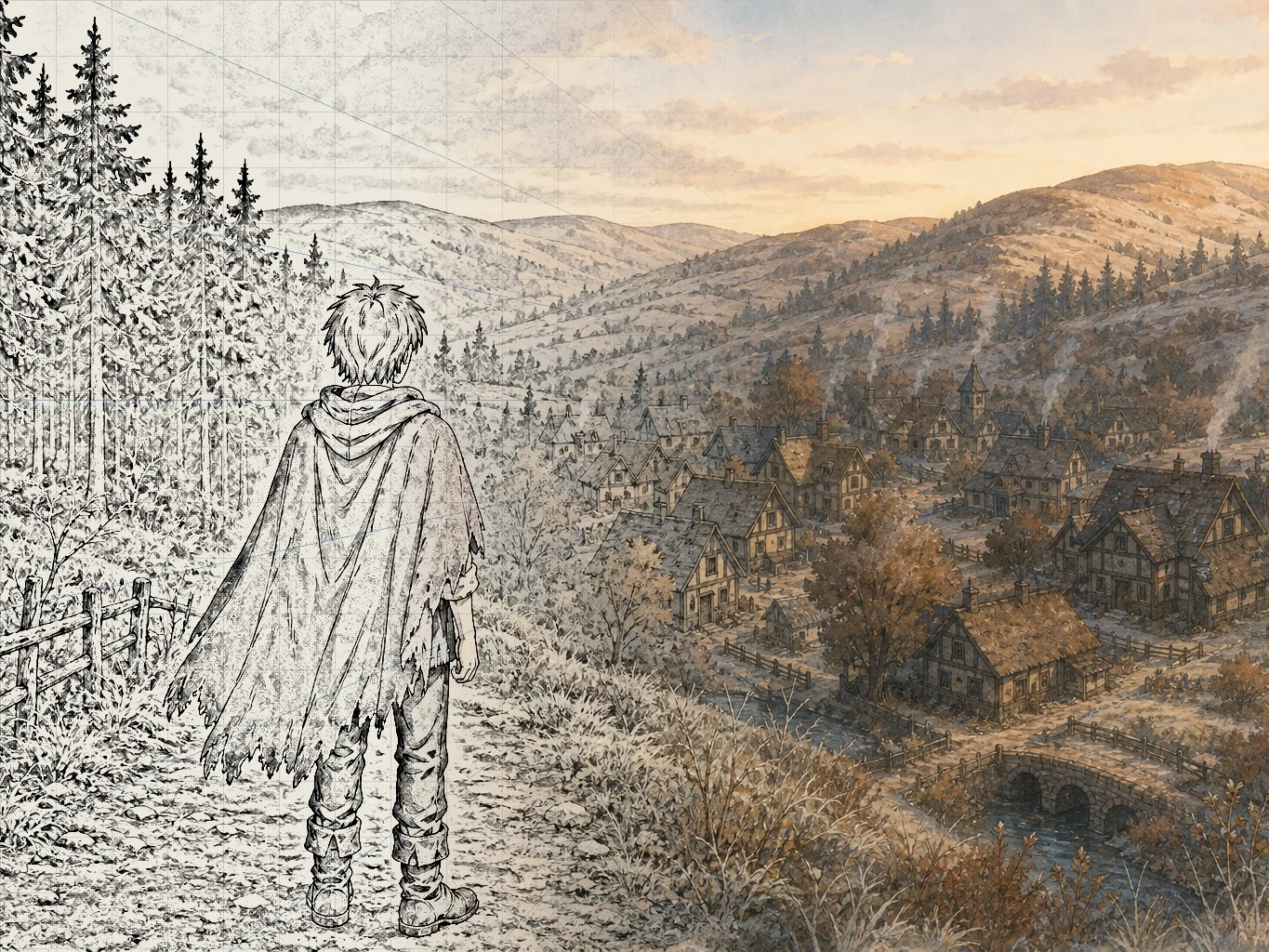
Windward Hollow lay around him like a coin in a crease — settled, small, going nowhere, the bare hills to the west and the dark wall of the Emberwood to the east. A quiet kind of village, measured out in chores and in low talk around a hearth, the pace of it unchanging, and no one in it seemed to mind.
This early — before the village woke properly, before the noise and the obligation and the small, relentless machinery of other people’s needs — he could almost believe that the world was a simple place, and that he belonged in it.
It had been enough for fifteen years. It would be enough for one more morning.
Inside, the kitchen was already warm with the scents of fresh bread and tea. Mirna stood by the hearth with flour on her apron, humming low to herself, a crease of concentration between her brows, the kind of expression she wore when the bread was at the stage where it might rise properly or might not, and there was nothing to do but wait. Above her, an old short sword hung crosswise on iron pegs, grey with the dust of years. On the doorframe to the back room, a column of small pencil notches climbed past Emrys’s current head — fifteen years of his rising, marked one birthday at a time. Garlen sat at the table, chewing toast as he studied a list of the day’s tasks, his reading glasses perched on the end of his nose in a way that made him look like a large, weather-beaten owl.
“You’re up early,” Mirna said, glancing over her shoulder. “The sheep don’t run away in the night, you know.”
A faint grin tugged at one corner of his mouth. “They might, if I gave them the chance.”
Garlen chuckled and set the paper down. “If you’ve got strength to spare, there’s plenty to do. Flock needs feeding, and the south fence won’t mend itself. Mind the big ewe. She used to put you flat when she was the taller of you, and Mirna and I never could keep our faces straight.”
“I’ll take care of it,” Emrys said at once.
“Good lad,” Garlen said, approval plain in his voice. Mirna stepped close and brushed a stray lock of hair from Emrys’s face, the gesture quick but careful, as if to check he was still there. Her fingers were warm from the bread dough and dusted with flour, and they left a faint white streak on his temple.
“And don’t forget to eat. You can’t help anyone on an empty stomach.”
“I’ll grab something on the way,” Emrys promised — though he rarely did. The morning air always filled him with a restless urgency, as if the world might change shape if he were not out in it before it properly woke.
He grabbed the bucket of feed and headed for the pasture.
The path away from the cottage was dark with dew, and the air bit pleasantly at his cheeks.
A few crows argued in the bare branches overhead, conducting some territorial dispute that had evidently been going on for days and showed no sign of resolution. The hedgerows on either side of the lane were brown and skeletal, stripped down to their winter architecture, and through the gaps Emrys could see the sheep meadow stretching away to the south — a wide, gentle sweep of frosted grass, silver in the early light, dotted with the pale shapes of the flock already moving toward the trough. Garlen had warned him a hundred times never to underestimate them; he himself had learned the lesson as a boy, on a rock that had taken the better part of his right knee.
He passed the Ashworth place, where the youngest boy — Aelios, quiet and watchful — sat on the front step with a book in his lap, turning pages with the focused attention of someone who preferred the company of words to people. He did not look up as Emrys passed. Emrys did not expect him to.
They teased him often, Darrin and the others — never quite cruelly enough to draw blood, but always finding the tender places, the gaps in his armour he had counted as sealed and hadn’t. He was halfway to the pasture when he saw them: the three of them at the old well at the bend, waiting, as they waited most mornings.
No family, no name. The words followed him down the lane like dogs at his heels, and they found the place they were looking for — the hollow space at the centre of him where the questions lived, the ones he had carried since he was old enough to understand what foster meant and what it did not.
Where did I come from? Why did they leave me? What was wrong with me that they couldn’t keep?
He had no answers. He had never had answers. And the worst part was that the absence of answers was an answer in itself — the silence where his history should have been was a verdict.
At the bend in the lane he glanced back. Darrin’s friends had already wandered off. But Darrin himself was still there, sitting alone on the edge of the well, and the smirk was gone. In its place was something Emrys had not seen before — a tiredness, a slackness in the shoulders, the posture of a boy who has just performed something and is now sitting in the emptied square after the fair has packed up and gone.
The observation arrived and departed in the same breath. Emrys turned back toward the pasture and did not think about it again.
The rest of the day passed in the rhythm of chores — the flock fed, the south fence mended, the kind of honest, repetitive work that asked nothing of him except his hands and gave him, in return, a few hours where the questions went quiet.
That evening, Garlen told him the south fence had never looked better. Mirna set an extra portion on his plate without being asked. The village needed him, and the village showed it in the small, steady ways that villages do.
He thanked them, and the thanks stayed only on the surface of him.
Later, when the lamps were trimmed and the kitchen was clean and Garlen had gone to his bed, Mirna stood for a long time at the window above the basin. Emrys passed the kitchen on his way to his room. She was silent, her hand resting against the cold glass, looking out at the dark lane. She did not turn when he passed.
He went to his room. He did not ask her what was wrong. He did not think she would have known how to answer.
He lay awake long after the cottage went quiet. He could not stop seeing her at the window — silent, unfocused, her hand against the cold glass. Mirna was not a woman who frightened easily. She had stood down wolves alone in the lane and stitched her own hand without flinching, and the steadiness of her was the steadiness the cottage was built on.
If something tonight had reached her, then something was reaching. And the part that kept him awake — worse than the words at the well, worse than the old questions in the dark — was the suspicion that whatever it was had been reaching for him.
Marginalia
1 noteOther readers’ notes are open for you to read. To leave one of your own — or to react to someone else’s — request full access.
Loved by Pablo