Prologue
The Prologue
This day would echo the world’s end — thousands of years after it had happened, and thousands before it would come to pass. The years grow thin, and of this age, none who yet lived knew the hour of its ending. For centuries, the echo had faded. Today, it would gather voice.
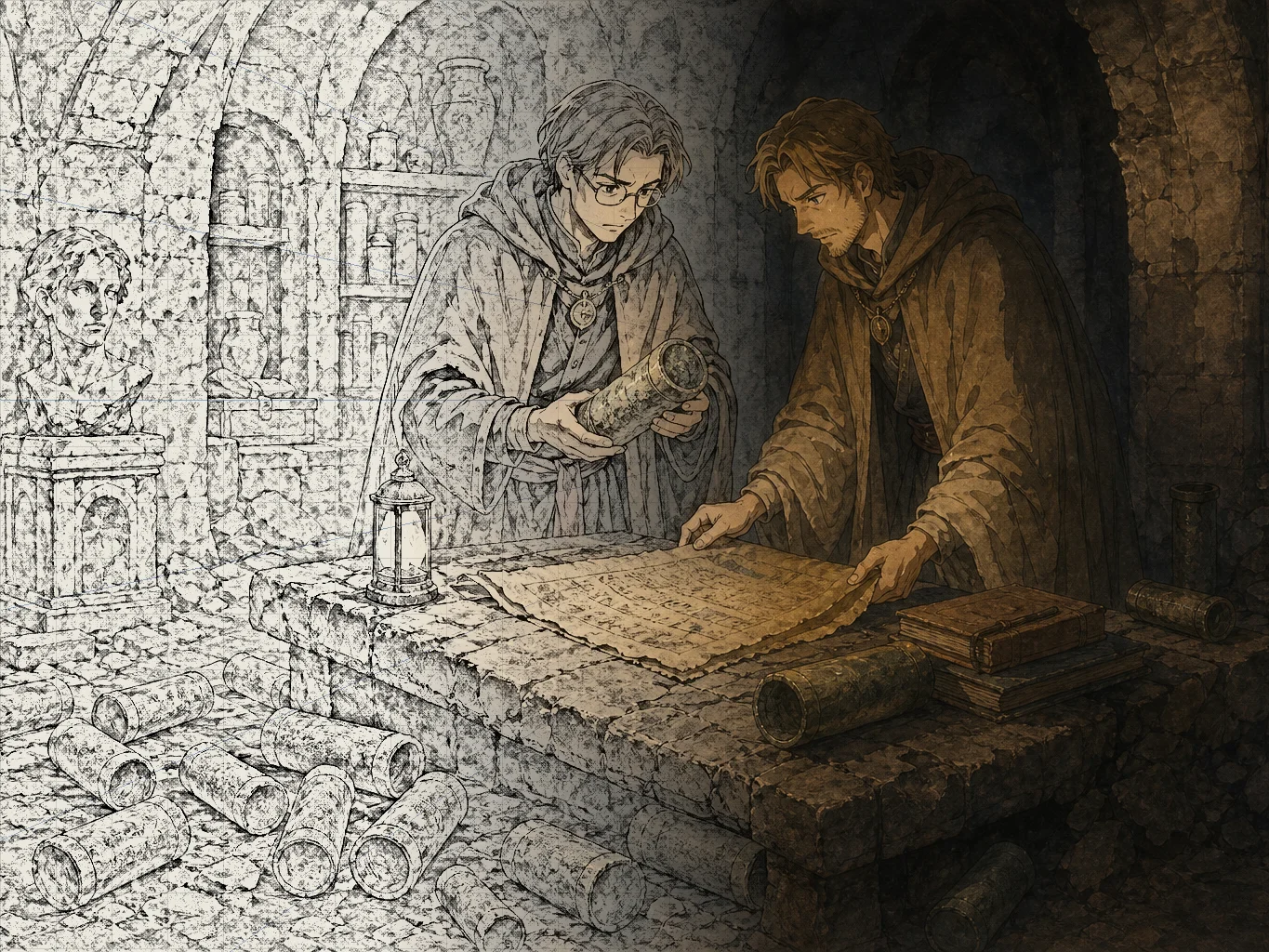
Twenty feet beneath the ruins of the Citadel, two men dug where no one had been meant to dig again.
The chamber had been mortared shut by a hand that meant the sealing to outlast itself, and the forcing of it had taken them three days and weakened something in the old stone that did not show until it was too late. The walls had begun to settle. Water had found the new cracks before the men did, a cold black seep sliding down the stone and gathering around their boots. Dust came down through the lantern-light in slow grey threads, and somewhere above them the stone had taken up a low, patient grinding that did not stop.
The younger man wanted to leave. He had wanted to leave since the first crack opened across the ceiling.
“It is enough,” he said. “We have the place. We can come back — with timber, with men, with the college behind us.”
“There will be no coming back.” The old scholar did not lift his eyes from the floor, where his fingers were working a shape loose from the dust: lead, wax-sealed, the length of his forearm. Around it lay fourteen others the years had softened to paste. This one the years had not touched. “There is never any coming back. Hold the light.”
He turned it to the lantern and the breath left him. Pressed into the wax was a mark he had spent his life chasing and never let himself believe he would hold — the seal of Artheon Vale of Vareth-Ka, whose words had come down to them only in fragments, and none, in all the ages between, sealed by his own hand.
“You know what this is,” he said. It was not a question.
“I know what they say of the things he sealed.” The younger man’s voice had gone thin. “That he sealed them for a reason. That what he learned of the Etherborn is not a thing a man reads and stays whole. If it is what you think it is, it could put a torch in every hand between here and the Capitol.” He looked up at the ceiling. “Some doors are mortared shut by men wiser than we are. Leave it.”
The chamber answered for him.
A roof-beam let go at one end and came down, and the wall behind it followed, and the dark filled with noise and falling stone. In the half-second the lantern still burned, two things lay within the old scholar’s reach: the cylinder, and the hand of the man who held the light.
He took the cylinder.
When the noise stopped he was alone, the lantern guttering where it had fallen, a slope of broken stone where his companion had been. He did not dig. There was no time, he told himself. The man was already gone, he told himself. The work was worth a life — Vale’s testimony, the truth of the breaking, was worth more than one frightened scholar who had wanted, at the last, only to go home. He told himself these things on his knees with the cylinder pressed to his chest, and he went on telling them as he climbed toward the grey light of the opening, because they were easier to carry than the silence underneath them.
He came up out of the earth into the last of the afternoon, and the first thing he saw was the riders.
They sat their horses along the crest of the hill, in no hurry, in riding cloaks the colour of dust. Worked large across the breast of each, in thread the pale grey of untarnished metal, was a mark he could read even at that distance — a many-pointed star caught inside a ring. He had seen it before, small and half-hidden: in the margins of histories he had not been permitted to read, at the throats of men who came asking after old scrolls and were never seen to leave a place empty-handed. He had never thought to see it ridden openly toward him.
For thirty years he had told himself they would never find him.
They had found him.
He went for his horse and was in the saddle before they moved, and then they all moved at once. The hills unrolled grey and gold beneath a failing sun, and behind him the riders came on — soft thunder over the open ground, neither gaining nor falling back, patient as the grinding stone had been patient, as though they had all the time the world had left. He looked back only once. Looking back cost him stride.
The Capitol rose out of the dusk, its walls gold in the last light and the broad river black around them, and the bridge boomed hollow under his horse, and the gates stood open, and he went through them at a gallop with the riders a hundred lengths behind. The gates swung shut. The guard turned at the clatter of him. And in the open ground beyond the wall the riders in the dust-coloured cloaks drew rein, and sat their horses, and did not come on — for they did not need telling that a thing carried through those gates was, for tonight, past the reach of a rider in an open cloak. They turned and went back the way they had come, unhurried, as men go who know the wall is only stone, the river only water, and the world is long.
In the deep quiet of the Hall of Records, where the noise of the chase could not follow him, the old scholar at last set the cylinder down.
He arranged the cloth, the cradle, the candle, with hands he could not quite hold still, and he sat before it for an hour without touching it. Thirty years he had given to a single question — the one the scrolls answered one way and the legends answered another, the one that had cost him, this day, a man’s life: were the Etherborn the saviours the old texts promised, or the destroyers the world remembered? The answer had lain sealed in lead for two thousand years. It lay now within reach of his hand, and he was afraid of it.
He gave the moment its hour. Then he warmed the wax apart, drew the brittle scroll from its case, and unrolled it across the cradle — dense with a hand that was formal and precise and grew, as the lines ran on, increasingly urgent.
He adjusted the candle. He began to read.
He read in silence, and the silence deepened as he went. It was no history. It was an account of the end of the world by a man who had lived through it — beyond the fiery skies, the folded cities, the dead past any counting was the writer’s own destruction: a wife, two daughters, torn body from spirit, now neither. He had written to warn that the thing which had done this was not gone but rather held back; that the stars would turn as they had before, and the bearers would return, and the next age would open its arms as this one had, and learn the same lesson in the same fire.
The colour left the scholar’s face by degrees. He drew his head back from the page as though from a heat, and read Vale’s final warning:
What comes through the Veil wears the shape of salvation and carries the appetite of ruin.
Marginalia
1 noteOther readers’ notes are open for you to read. To leave one of your own — or to react to someone else’s — request full access.
Loved by Pablo