Chapter 9
Bridge of Fire
On the fourth day, the forest ended.
It did not thin or taper. It stopped — a clean line of trees, and then open country, as though the Emberwood ended exactly where it meant to, and had no interest in negotiating. Emrys stepped out of the tree line and the sky hit him like a physical force, enormous and pale and stretching in every direction, and after three days under the canopy the vastness of it made him dizzy.
The land beyond was hill country. Rolling, treeless, covered in brown grass that moved in the wind like the pelt of some enormous sleeping animal. A road cut through the valleys — not a village road but a trade road, wider and older, packed hard by generations of use. It ran east.
Emrys followed it.
The openness was its own kind of fear. Nowhere to hide. Nowhere the eye could not reach. The wind was constant and cold and came from the north, carrying nothing — no smell of smoke or settlement, no sound of life. Just the empty breath of land that had been uninhabited for a very long time.
He walked for most of the morning. He passed no one. The hills rolled and the grass moved and the sky was flat and grey, and the world was emptied out, as though something had swept through this country and the sweeping had been thorough.
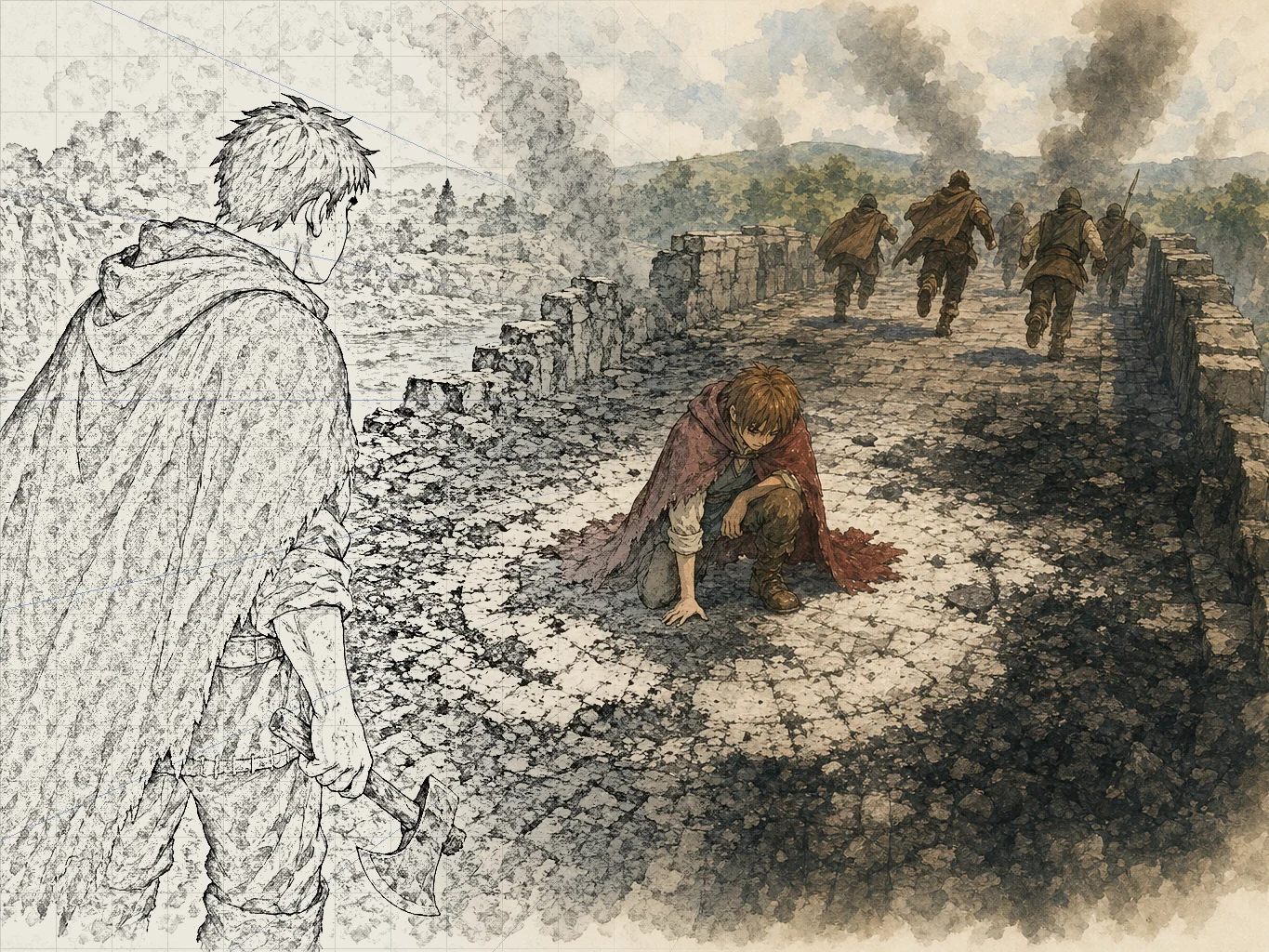
He found the stone bridge around midday. It spanned a shallow river at a point where the road dipped between two hills. The bridge was old — stones fitted without mortar, each one shaped to lock against its neighbours, the craftsmanship cleaner and more precise than anything in Windward Hollow. The stream beneath ran clear and cold, and the sound it made was the first water-sound since the forest, and it was pleasant, and the pleasantness made him careless.
He was halfway across when the first man stepped out from behind the far abutment.
There were four of them.
Two blocking the road ahead. One behind, emerging from the ditch. A fourth on the hillside — the lookout who had let Emrys walk into the trap before signalling the rest.
Road people. Lean, weather-beaten, dressed in patched wool and scavenged leather, carrying weapons built for function: a notched short sword, a hatchet, a length of chain, a nail-studded club. Their faces had the hardness hunger makes — not cruel by nature but sharpened into something cruelty could borrow.
The leader — tall, a scar bisecting the corner of his mouth into a permanent half- sneer — held the notched sword loosely against his thigh.
“Bag. Knife. Whatever’s in your pockets. Quick, and you walk away.”
Emrys’s hand went first to the sword on his back. His fingers found the hilt. He pulled. The blade caught half-clear of the scabbard — the strap, the angle, something — and jammed. He let it go and reached for the knife at his belt instead. Garlen’s knife. The bone handle smooth under his thumb. That, at least, would come when he called it.
“I can’t do that,” he said.
The scarred man tilted his head. “You can, boy. You just haven’t decided to yet.”
The one behind him moved closer. Emrys turned — a mistake, his back to the two in front — and the scarred man closed the distance in three fast strides. The sword came up. Emrys stumbled. His boot caught the bridge edge and he went down hard on one knee, and the scarred man was above him, blade raised, and Emrys threw his hands up—
And then, the fire came.
It came from everywhere.
It erupted from the bridge stones as though the rock had been holding a breath of flame and had finally exhaled. It surged outward in a ring — not fire exactly but a wave of heat and light so intense the air buckled around it, bending like water around a stone — and the sound was a concussion, a single pulse that hit the four men like a fist and threw them backward.
The scarred man landed six feet away, rolling, his sleeve smoking. The ditch man was knocked into the stream. The two on the hillside scrambled back, and the one with the club dropped it and ran, and the running broke the rest of them — one man running gives the others permission — and within seconds all four were in full retreat, stumbling over brown grass, not looking back.
The bridge was empty except for Emrys.
He was on his knees, hands pressed flat to the scorched stone, breathing in ragged, animal gasps. The bridge around him was black. The stones where he knelt had been bleached to chalky white in a perfect circle. The grass on both sides was burning in scattered patches, smoke rising in threads the wind shredded and carried away. The air smelled of hot stone and scorched grass and something animal — singed hair, his own — and the realisation turned his stomach.
His hands were shaking — the deep, bone-level tremor of a body that had done something it did not authorise and was now paying for it. The cold arrived from the inside out. A hollowness that started at his breastbone and worked outward through his arms and legs, scouring as it went, leaving his limbs heavy and distant, as though they belonged to someone further away than he was. His thighs trembled under his own weight. There was a sour taste in his mouth he did not recognise — the taste of a body that had burned through its own reserves and had nothing left but the shaking. The heat was still in him, coiling in his chest, restless, unsatisfied, wanting more as a flame always wants more. The rest of him was empty. He pressed his forehead to the stone.
“Please stop. Please.”
The heat subsided. Slowly. Grudgingly. Not because he told it to but because it decided to, and the difference was what terrified him most. He was still kneeling when the voice came behind him.
“I knew it.”
Emrys turned, still on his knees. Darrin stood at the near end of the bridge.
The swagger was gone. In its place was something leaner and harder — the look of a person who has been walking for days on insufficient food and too much purpose. His face was thinner. His hair was unwashed. He wore a travelling cloak too large for him — his father’s, probably — and beneath it the same rough-spun clothes from the morning Emrys had last seen him carrying flour. His boots were caked with the reddish mud of the eastern Emberwood. He had been following for days.
In his hand he held a hatchet. The baker’s hatchet. Not a weapon, but held like one — knuckles white, blade turned outward.
His face was a country at war.
“I knew there was something wrong with you,” Darrin said. His voice was shaking. “Always knew it. The way the fire moved around you in that house. The way you walked out like nobody else could have. I told myself it was nothing—”
He took a step onto the bridge. The scorched stones cracked under his boot.
“Destroyer!”
The word hit Emrys in the chest — not like a slap but like a key turning in a lock. Because Darrin was not Aldric Thane muttering about legends. Darrin was the boy from the well, the boy from every morning, the voice that had found every crack in Emrys’s armour for years and pressed. And this time the crack he found was the deepest one — the one Emrys had been circling for three days alone in the forest, the one that lived at the bottom of every question he had asked in the dark. What if he’s right?
“You’re one of them,” Darrin continued, advancing, the hatchet trembling. “The Etherborn. The ones who broke the world. We took you in — the whole village took you in — and you’re the thing they warned us about.”
Emrys got to his feet. The motion was not calm. His legs were shaking. His vision was blurred and it took him a moment to understand why, and then he understood: he was crying. Not the dignified kind — the kind that arrives all at once when a body has been holding itself together too long. Tears unchecked, the ragged, hiccupping breath of a boy who had been holding himself since Windward Hollow.
“You think I don’t know that?” Emrys’s voice cracked. It came out wet and raw and loud, louder than he intended, loud enough to echo off the hills. “You think I haven’t been asking myself that every single day? You think I wanted this? You think I asked for—”
He gestured at the scorched bridge, the burned grass, the circle of bleached stone. His hand was shaking — and not just from emotion. The heat was rising again — summoned up out of a body that had nothing left to give it, pulled from the emptiness by the rage and the grief and the shame like a fever climbing in a man who has already burned through his fuel. He could feel it climbing his arms like a creature alive, no longer feeding on air but on him.
“You called me orphan,” Emrys said, and his voice broke on the word. “You called me stray. Every single morning. Every. Single. Morning! And now you follow me into the wild and call me destroyer, and you stand there with your father’s hatchet like I’m some kind of monster, and you don’t — you have no IDEA—”
The heat surged. The air around him shimmered. The stones beneath his feet began to glow — faintly at first, then brighter, a deep amber that pulsed with the rhythm of his heartbeat. Darrin stumbled backward, his face draining of colour, and the fear in his eyes was total now, the raw animal terror of a creature that has cornered something it cannot outrun. Emrys closed the distance. He did not decide to. His body moved the way it had moved toward the Ashworth fire — without consultation, without permission. But this time the motion was not brave. It was fury that he had accepted. Three steps and he had Darrin by the front of his cloak, and Darrin’s back hit the bridge rail, and the hatchet clattered to the stones, and Emrys’s free hand found the knife at his belt and drew it and pressed the point beneath Darrin’s jaw, and the blade was hot — visibly hot, the metal glowing dull red along its edge — and the heat radiating from Emrys’s body was a furnace now, blistering, the air between them rippling like a road in summer.
Darrin could not speak. His mouth was open but nothing came out. Tears streamed down his face — not from the heat but from the fear, the pure, paralysing fear of a boy who has just understood, in the most visceral way possible, that he is going to die.
Emrys’s arm shook. The knife trembled against Darrin’s throat. Every wound Darrin had ever dealt him was screaming for this — every morning at the well, every sneer, every casual cruelty that had found its target and lodged there and festered.
The knife stopped trembling.
There were no scales to balance. There never had been. The years had been a slow burn under his ribs every morning of his life, and the boy in front of him had been the one feeding it, and the boy did not get to walk away from what he had built. He had chosen the smirk. He had chosen the words. He had chosen them as other people choose what to wear, and the choices had scorched Emrys clean of any mercy he might have spared, and there was nothing left in him now to argue. The blood on the steel was the first honest answer Darrin had ever given him.
His sight dimmed at the edges.
He deserves this.
The knife pressed harder. A bead of blood appeared on Darrin’s neck, vivid against his white skin. The blood steamed where it met the hot steel.
And then: Darrin’s face.
Not the bully. Not the baker’s son. Not the boy at the well. Just a face. A human face, terrified, weeping, the eyes wide and fixed on his with the absolute certainty that the next second would be the last — and in that face was something that cut through everything in him the way nothing else could have. There he was.
There he was, sitting on the stool in front of the hearth, flinching at the pop of a shifting log. There he was, standing in the doorway of the Ashworth house, frozen, the fire roaring, every part of him screaming to run. The same fear, the exact same fear, the same animal terror of something that is bigger than you and does not care about your survival — and it was on Darrin’s face the way it had been on his own face a thousand times, and the recognition was a blade sharper than the one in his hand.
This is what they’re afraid of. This is what a destroyer looks like. And I am choosing to be it.
The thought broke something inside him. Not gently — violently, like ice breaking in spring, loud and sudden and irreversible. The break happened, the fury cracked and the fire stuttered, and in the space that opened — the raw, aching space between rage and grief — he found something he had never found before.
A choice.
Not a plea. Not the begging of the campfire, or the bridge. A choice. His. Made not with his hands but with the deepest part of himself, the part that had walked into a burning house because a boy was screaming, the part that had lifted Aelios from the smoke, the part that had stood in the Emberwood beneath a sky full of stars and had not broken.
No.
He said it aloud. Not to Darrin. Not to himself. To the fire.
“No.”
And the fire listened.
It did not subside grudgingly this time — not like the campfire, not like the eruption on the bridge. It pulled back — swiftly, cleanly, like a tide reversing. His sight cleared. He did not mark the clearing. The heat drained from his arms, from his hands, from the knife. The blade cooled. The glow faded from the stones. The shimmering air went still.
The bridge was quiet.
Emrys looked at the knife in his hand. At the point of it, a hair’s breadth from Darrin’s throat. At the bead of blood, already cooling on the steel. His hand was steady now — not the steadiness of rage but the steadiness of something settled, something decided, something that would not be undone.
He lowered the knife. He released Darrin’s cloak. He stepped back.
Darrin slid down the bridge rail and sat on the scorched stones with his legs drawn up and his arms around his knees. His face was slick with sweat, his eyes closed, his mouth working around words that would not come. His shoulders shook in silence, and the silence was worse than screaming.
Emrys stood over him, breathing hard, the tears still wet on his own face, the knife at his side, the heat gone from his body but the memory of it everywhere — in the scorched stones, in the steaming blood, in the brown smear on the blade where the metal had been hot enough to sear.
He sheathed the knife. His hands trembled so badly the blade found its sheath on the second try. He wiped his face with his sleeve and the sleeve came away wet and he did not care. The cold that had started at his breastbone had finished its work; it had reached his hands and his feet and the tips of his ears, and it was an interior cold, the kind that arrives when a body has spent something it did not know how to ration. His vision greyed at the edges. The sound of the stream beneath the bridge reached him as though through a wall.
He sat down on the bridge. Not across from Darrin — beside him. He did not so much choose to sit as lose a negotiation his legs had been having since he released the cloak; they stopped arguing and he went down, a controlled fall, his back finding the rail on the way and his hands landing loose in his lap because his arms did not have the strength left to do anything else with them. Close enough to reach. Not reaching.
They sat like that for a long time. Two boys on a burned bridge, crying in the wind, with the empty hills around them and the stream beneath them and no one for miles in any direction to see or judge or intervene. The smoke cleared. The scattered grass fires died. The bridge cooled.
Darrin spoke first. His voice came from behind his knees, muffled and raw. “You were going to do it.”
Emrys closed his eyes. The truth of it sat in him like a stone.
“Yes.”
“What stopped you?”
A long silence. The wind. The stream. The distant, indifferent sky.
“Your face,” Emrys said. “You looked the way I feel. Every time. In front of the hearth. In front of the fire. Every time I’m afraid of what’s inside me.” He opened his eyes. “I looked at you, and I saw what I was becoming, and I couldn’t—”
He stopped. The sentence did not need to be finished.
Darrin lifted his face from his knees. It was streaked and swollen and nothing like the face of the boy at the well. He looked at Emrys — really looked, the way Mirna looked, the way the stranger at the door had looked, the way you look at someone when you have run out of assumptions and are seeing them for the first time.
“I followed you because of the fire,” Darrin said. His voice was barely above a whisper. “The night at the Ashworths’. You went in and I didn’t. And I’ve been carrying that every day since. I thought if I followed you, I could — I don’t know. Prove something. To myself. That I wasn’t—”
He couldn’t finish. Emrys didn’t need him to.
“You called me a destroyer,” Emrys said.
Darrin flinched. “I know.”
“Do you believe it?”
Darrin looked at the scorched bridge. At the bleached circle. At the place where Emrys had pinned him. At the place where the knife had touched his throat. At the place where Emrys had pulled it away. “No,” he said. “A destroyer wouldn’t have stopped.”
The words hung in the air between them. They were not an apology and they were not forgiveness.
Emrys stood. He offered his hand.
Darrin looked at it. The hand that had held the knife. The hand that had burned. The hand that had let go.
He took it.
Emrys pulled him to his feet, and they stood on the scorched bridge in the cold wind, two boys from the same village who had never been further from home, and neither of them was the person they had been an hour ago, and the road stretched east, and it was long, and it was empty, and it did not care what they had been. It only cared that they were walking.
“I don’t know what I am,” Emrys said. His voice was hoarse. “I don’t know what any of this means. But I’m going east. And the road is easier with two.”
Darrin picked up his hatchet from where it had fallen. He looked at it — the baker’s tool, brought on a journey it was never meant for. He slid it through his belt.
“East,” he said.
They walked.
The preview ends here
You’ve reached the bridge of fire.
The road stretches east — through the citadel, the harbor, the capitol, and the coast — for another twenty-one chapters. To read on, request access. I review each one by hand, usually within a day.
Friends, family, and trusted readers welcome.
Marginalia
No notes yetOther readers’ notes are open for you to read. To leave one of your own — or to react to someone else’s — request full access.
No notes here yet.